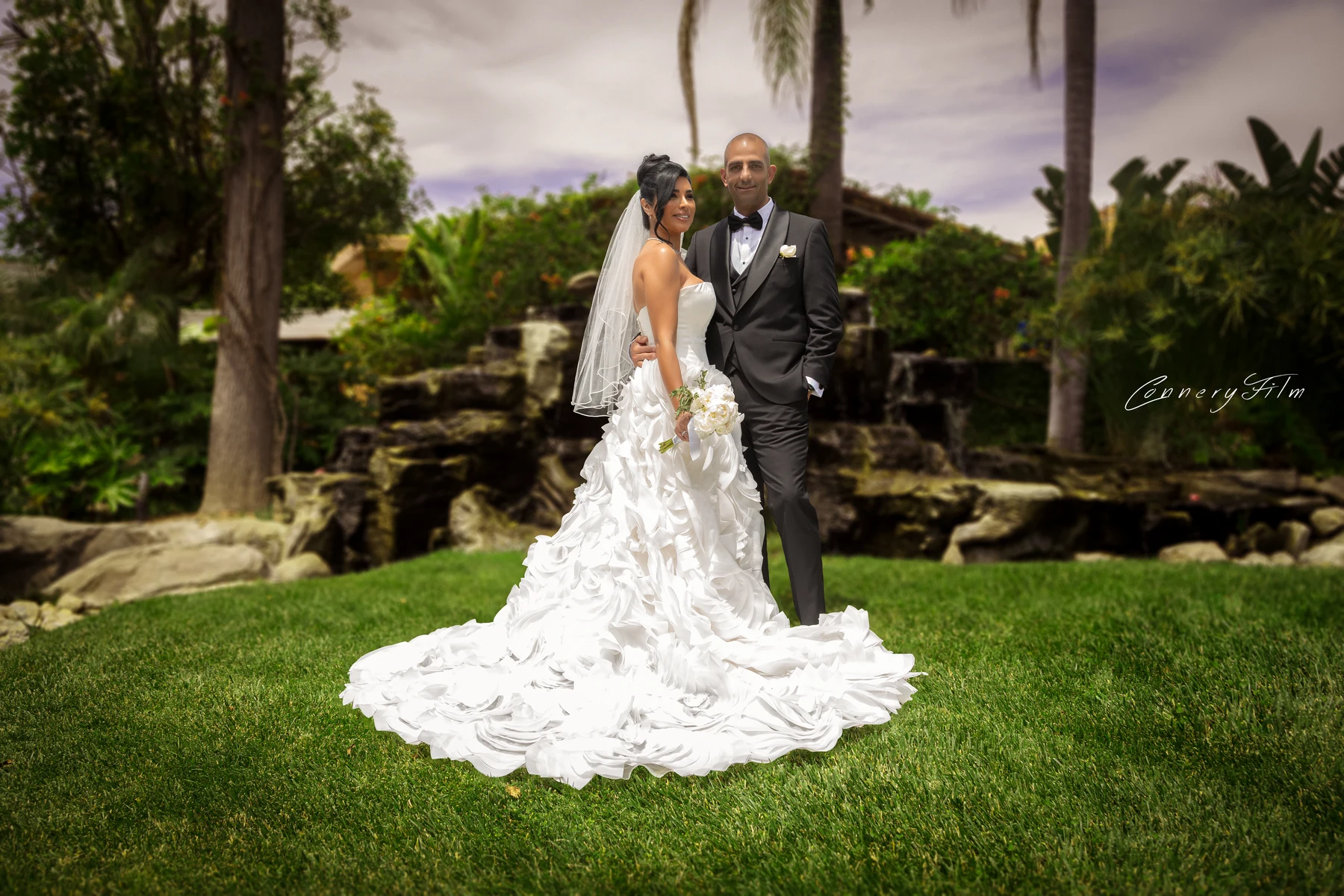
Almost every question I get about indoor wedding photography in Los Angeles is really a question about light. Couples ask me about lenses and cameras, but the ballroom at the Millennium Biltmore does not care what camera you own. It cares that the chandeliers are on a dimmer, the walls are dark walnut, and the only window faces an alley. I have been photographing weddings for 17 years, a huge share of them indoors, and the single thing that separates good indoor coverage from a gallery full of orange mush is whether the photographer walked in with a plan for light instead of a hope.
So here is what I actually do, venue by venue, hour by hour. Some of this is for couples deciding who to hire. Some of it is for the photographer reading this at 1am the night before their first indoor wedding. Both of you need the same information.
The blunt version: indoors, you make the light or you lose the photo
I'll be blunt, because most photographers won't say it out loud: a photographer who refuses to use flash indoors is not being artistic, they're being underprepared. "Natural light only" is a beautiful philosophy at 4pm in a garden in Pasadena. At 9:15pm in a windowless reception room in Downtown LA with the uplights turned magenta, it means a wall of grainy, color-shifted frames where nobody's skin looks like skin.
You do not have to blast people with a bare on-camera flash. I bounce almost everything. But there has to be a light source you control, or the room decides what your wedding looks like, and rooms make ugly decisions. If you're comparing photographers, ask this exact question: "What do you do when the reception room is dark?" A good answer names gear and technique. A vague answer about "working with what's there" tells you what your dance floor photos will look like.
Find the window first, always
The first thing I do at every indoor venue is walk the room and find the biggest window, then figure out what time of day it's useful. This takes four minutes and improves the entire gallery.
Getting-ready rooms are where this pays off most. Hotel suites in LA almost always have one wall of glass and three walls of beige. I move the chair, the mirror, the whole hair-and-makeup setup if I have to, so the person is turned toward that window. Overhead hotel lighting is the enemy here: it's yellow, it's directly above, and it puts shadows in eye sockets. I turn the room lights off. Every time. Someone always asks if I need more light and the answer is that I need less of the wrong light.
Practical numbers for a window-lit prep room: I'm usually at f/2, 1/250 second, ISO 640 to 2000 depending on how far into the room I've pulled them. If you want the full breakdown of how I set exposure on a wedding day, I wrote about the settings I actually use across a Los Angeles wedding in more detail.
Ceremonies indoors: know the venue's rules before the day
Los Angeles churches vary enormously, and the difference is not aesthetic, it's operational. St. Sophia Greek Orthodox Cathedral is gorgeous and genuinely dark, and like many houses of worship it restricts where you can stand and whether you can use flash at all. The Cathedral of Our Lady of the Angels, by contrast, has alabaster panels that flood the nave with soft daylight — it's one of the easier indoor ceremonies in the city if you're shooting midday. A hotel ballroom ceremony sits somewhere in between and is usually the darkest of the three.
If flash is not allowed, and often it isn't, you're shooting available light and you need fast glass. My ceremony kit indoors is a 35mm and an 85mm, both f/1.4, and I will happily run ISO 6400 on a modern full-frame body. Grain is fine. Grain is a texture. Motion blur on the ring exchange is not fine, and it is unrecoverable. So I protect shutter speed first: 1/200 minimum for people standing, 1/320 if there's a processional walking toward me. Everything else bends around that.
This is one of the places where auto ISO earns its keep — I lock aperture and shutter, let the camera chase the exposure as I swing from the dim altar to the bright aisle, and I keep shooting. I explained how I configure auto ISO for weddings if you want the actual menu settings.
Mixed lighting is the real problem, not darkness
Darkness is a solvable problem. Mixed color temperature is the one that quietly ruins galleries.
Picture a typical LA reception: tungsten chandeliers at roughly 2800K, LED uplights washing the walls in deep purple, a DJ's moving heads throwing green across the dance floor, and a window still leaking blue evening light at 7pm. There is no white balance setting that makes all four correct at once. If your photographer shoots that scene on auto white balance and does nothing else, you get faces that are orange on one side and green on the other, and no amount of editing fixes it cleanly.
What I do instead:
- Gel the flash to match the room. A CTO gel on the flash brings it down to tungsten, so my light and the venue's light agree with each other. Then one white balance setting works for the whole frame.
- Kill the worst offender. If the uplights are a color nobody chose on purpose — I'm looking at every magenta uplight package ever sold — I'll ask the DJ or coordinator to switch them to a warm amber during dinner. They almost always say yes. Almost nobody thinks to ask.
- Shoot RAW, and set white balance in-camera anyway. RAW gives you the latitude, but starting close means 600 photos edit consistently instead of one at a time.
- Watch for overexposed highlights on white dresses under spotlights. A blown-out dress has no detail to bring back. I meter for the dress and let the background go dark — that's a choice, and it's the right one. I've written more about why indoor wedding photos come back overexposed and how to prevent it.
How I light a dark reception
Here's my actual setup for a dark ballroom, and it is not complicated or expensive.
On camera: one flash, gelled CTO, pointed up and behind me at about 45 degrees, at roughly 1/8 to 1/4 power. If the ceiling is white and under about 15 feet, that bounce turns the whole ceiling into a giant soft light and the photos look like the room is simply well lit. Nobody sees a flash going off in their face.
The catch: LA venues love dark wood ceilings, black draped tenting, and 30-foot industrial rafters. Bounce dies in all three. When I can't bounce, I put a small softbox or a bounce card on the flash and accept a more directional look, and I back off the power so it reads as ambience rather than a police searchlight.
Off camera: one light on a stand behind the dance floor, aimed back toward the crowd, at 1/16 power. That single rim light is the difference between a snapshot of people dancing and a photo with depth. It costs nothing and takes six minutes to set up during dinner. If a photographer's dance floor photos all look flat and frontal, this is the piece they're skipping.
One more thing about receptions: I keep the ambient exposure alive. If I underexpose the room to nothing and let flash do all the work, the candles disappear, the string lights disappear, and the room your florist spent months building disappears. Slow the shutter to 1/60, let some ambient in, then add flash on top. The room stays in the photo.
What I'd do if it were my own wedding
If I were planning an indoor LA wedding, I would move one thing on my timeline and one thing only: I'd do portraits before the ceremony, near a window, while there was still daylight in the building.
Couples resist this because of the first-look question, but that's a separate decision — you can do a private first look, or a first touch around a corner, or just have your photographer shoot you separately in that light. The point is that a 4:30pm portrait beside a hotel window looks like a magazine, and the same portrait at 9pm in a hallway looks like a hallway. Indoor weddings run out of good light earlier than couples expect, and once it's gone, it's gone. I lay this out in more detail in my realistic LA wedding day photography timeline.
The second thing I'd do is hire one team for photo and film. This matters more indoors than outdoors, and here's the mechanical reason: in a dark room, the video team's constant lights and the photo team's flashes are literally shining into each other's frames. When my photo and video crews are the same studio — which is how we run every ConneryFilm wedding — we position lights once, together, so the video light doubles as a soft source for stills and nobody's footage has a strobe pop in it every three seconds. Two separate vendors in a dark ballroom means two people quietly fighting over the same six feet of floor all night.
Small things that fix indoor photos
- Ask about the ceiling before the wedding day. White and low means bounce flash. Black, wood, or 25 feet up means bring stands.
- Turn off the overheads in prep rooms. Window plus lamp off beats window plus yellow ceiling can every single time.
- Move people three feet. Most bad indoor photos are fixed by stepping the subject away from the wall and closer to the window. Three feet changes everything.
- Use a wall as a reflector. A white wall opposite a window is free fill light. Put the darker side of the face toward it.
- Bring more batteries than you think. Flash-heavy receptions eat AAs. I carry 24 and I've used them.
- Watch the exit signs. Every venue has one, it's bright green, it's always right behind someone's head, and it will tint the whole side of a face. Compose it out or gel around it.
Cost, in real Los Angeles numbers
A photographer who handles indoor lighting properly is not a budget hire, because the skill takes years and the gear is real. In LA, wedding photography from a studio that lights confidently starts around $1,599 for smaller coverage and lands most often between $3,500 and $6,500 for a full eight-to-ten-hour day. Adding a second photographer to cover the dark reception from a second angle typically runs $600 to $900. Photography and cinematography together, one team, generally starts around $3,500 and scales from there depending on hours and deliverables.
The cheap end of the market is where indoor weddings go wrong most often, because a $900 photographer usually does not own two flashes, two stands and the fast primes an indoor ceremony demands. That's not a character flaw, it's math. The equipment to light a ballroom well costs more than the package.
Common questions about indoor wedding photography
Do I need a photographer with flash if my venue looks bright?
Yes — because "bright" almost always means bright at 2pm during your tour, and your reception is at 8pm. Walk your venue at the same hour your wedding will actually be happening, or ask your photographer to. A room that glows at noon can be nearly black after sunset.
Will flash be distracting during my ceremony?
Not the way I use it, and often it isn't allowed anyway. During ceremonies I shoot available light with fast lenses at high ISO. Flash comes out for the reception, bounced off the ceiling, where the music is loud and nobody notices it.
Why do my friend's indoor wedding photos look grainy and orange?
Two causes, usually together: the photographer pushed ISO past 8000 to avoid using light, and the room's tungsten and LED sources were never balanced. Grain alone is fixable and even attractive. Grain plus color casts across mixed sources is what makes photos look amateur.
Should I schedule portraits before sunset even for an indoor wedding?
Absolutely. Daylight coming through the venue's windows is the best light your indoor wedding will have all day, and it disappears on a schedule you can look up. Portraits 60 to 90 minutes before sunset, even inside, will be the frames you print.
How many indoor photos should I expect from an 8-hour wedding?
The same as any other wedding: roughly 500 to 800 edited images. Indoor conditions change how hard I work, not how much you receive.
Can one team really handle both photo and video in a dark venue?
It's actually easier than two teams. One crew sets one lighting plan that serves both the stills and the film, and there's no negotiating over positions during the first dance. That's exactly why we keep photography and cinematography under one roof.
If you're planning an indoor wedding anywhere around Los Angeles and you want to talk through your venue, your timeline and what your light will really be doing at 8pm, I'd genuinely enjoy the conversation — bring your floor plan and your questions. Call or text 818.749.7039, or see the work and the packages at ConneryFilm.com, and let's make sure your rooms look like the rooms you fell in love with.
Meet the Author: Connery Davoodian Hello, I'm Connery Davoodian, the visionary behind ConneryFilm, and I'm thrilled to share insights from my 17-year journey through the world of wedding photography and videography. My passion extends beyond simply capturing images; it's about artfully weaving your unique love story into a timeless, cinematic masterpiece. My artistic path began long before I ever picked up a camera, deeply rooted in music as a singer, songwriter, and multi-instrumentalist. This diverse background in directing, producing, and editing has cultivated a unique perspective, allowing me to approach each wedding not just as an event, but as a dynamic narrative waiting to be beautifully told. This blend of technical mastery and creative storytelling is the heartbeat of ConneryFilm, ensuring that every frame, every shot, and every film is infused with depth, emotion, and unparalleled artistic integrity. At ConneryFilm, we believe your wedding memories deserve nothing less than bespoke luxury. My philosophy centers on capturing the authentic, unscripted moments – the genuine smiles, the tender glances, the joyful laughter – that truly define your day. While we obsess over exquisite details and sophisticated aesthetics, our true joy comes from making you feel completely at ease, like a "friendor" who genuinely celebrates alongside you. This calm, organized presence allows your true personalities to shine, resulting in images and films that are as real and vibrant as your love itself. Based in the heart of Los Angeles, California, my team and I are privileged to serve couples across the globe, bringing our signature high-end wedding photography and videography to destination weddings worldwide. Through these blog posts, I aim to share invaluable insights, luxurious inspiration, and practical, fun advice to guide you through your wedding planning journey, helping you make informed decisions about preserving your most cherished moments. Thank you for trusting ConneryFilm to be a part of your extraordinary adventure. I'm excited to share my knowledge and passion with you, helping you create memories that will last forever.