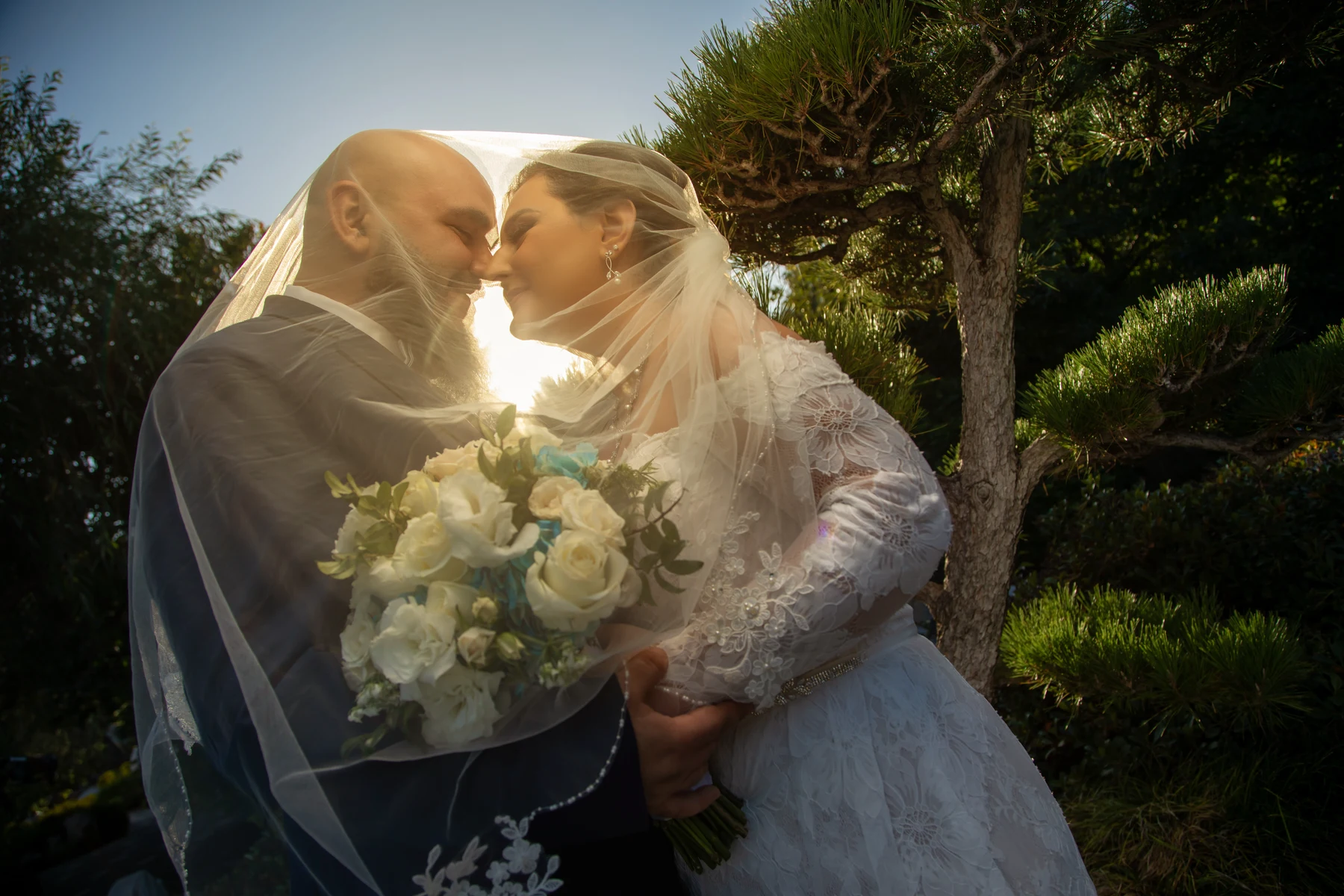
Armenian Wedding Photographer & Cinematographer in Los Angeles
I'm Connery Davoodian. I've spent 17 years photographing and filming weddings across Los Angeles, and a large share of them have been Armenian — in Glendale, Burbank, Montebello and Pasadena. This page isn't a template with a word swapped in. If you're Armenian, or you're marrying into an Armenian family and trying to understand what's coming, I want you to finish reading and think: he's actually done this before. Because knowing the order of the day is the difference between a photographer who catches the crowning and one who's still fumbling with a lens when the crowns come off the couple's heads.
The day runs in a specific order, and I shoot to it
An Armenian wedding day usually starts long before the ceremony. There's the getting-ready, then the home visit — the groom and his party arrive at the bride's home, often with flowers, sometimes a serenade at the door, and the two families meet in a room that fills up fast. This is where I earn my keep by being small and quiet. The light in a family living room is rarely kind, so I'm not blasting flash into grandmother's face; I read the room and work with the window I've got.
Somewhere in there comes the stealing of the bride's shoe — the bride's younger relatives hide a shoe and the groom's side has to negotiate, and pay, to get it back. It's fast, funny, and it happens in a huddle. If you're standing in the wrong corner you miss the faces, which are the whole point. I position for the reactions, not the shoe.
If the bride or a family member is wearing the taraz, the traditional Armenian dress, I make sure we photograph it properly and unhurried — the embroidery and the silver belt deserve real frames, not a snapshot on the way out the door. These are heirlooms and they photograph beautifully when someone slows down for them.
Inside the Apostolic church: what a photographer can and can't do
The heart of the day is the crowning ceremony in the Armenian Apostolic church. The couple stands before the altar and crowns are held over their heads while the priest blesses them and they share the common cup. It is the image every family expects to see. Here's my blunt stance: a photographer who doesn't know church etiquette becomes the problem. In most Apostolic churches you do not step onto the soorp khoran, the raised altar area, and you keep your distance during the sacred parts. Some priests forbid flash; some restrict where you stand entirely. I've shot enough of these to know the geography of the churches around Glendale and I plan my angles before the couple walks in, using fast lenses and available light rather than fighting the clergy. This is exactly why I lean on the settings I explain in my piece on using Auto ISO for weddings — a dim sanctuary with the couple lit only by the altar candles is not the place to be chimping at your dials.
Because I bring photography and cinematography from one team rather than two vendors tripping over each other in a tight sanctuary, we've already agreed who covers which angle of the crowning. Two separate companies meeting for the first time at the altar is how you get a videographer's tripod in every photo — and vice versa.
The reception: kef, the shurjbar, and a night that does not end early
Armenian receptions are loud, generous and long. The kef music starts and the floor rarely empties. The shurjbar — the circle dance — pulls in everyone from toddlers to the eldest uncle, and it moves. Shooting it means anticipating the direction of the circle and getting into the middle without becoming an obstacle. This is not the moment to be timid at the edge.
Two things I say to every couple. First, the extended-family group photos are enormous and non-negotiable, and they take real time — a focused plan beats chaos, which is why I build these out ahead of the day the way I describe in my approach to a wedding shot list. Second, these nights run late. Most LA photographers, as I've written about when photographers leave the reception, are gone by 10:30. Armenian dancing is often just warming up then. If you want the tail end of the party covered, book the hours for it — I'll tell you honestly what your day needs in my guide to coverage hours rather than selling you a package that clocks out mid-shurjbar.
Venues I actually know across Armenian LA
Glendale is the center of Armenian Los Angeles, and the surrounding cities carry the rest. These are rooms I've worked in or right beside:
- Glenoaks Ballroom (LA Banquets), Glendale — an LA Banquets room built for large Armenian celebrations, big guest counts and a dance floor that fills. I plan my group-photo staging before the room turns into a party.
- Anoush Landmark, Mission Hills — an LA Banquets hall that seats 850-plus. When your family list runs into the hundreds, this is the kind of scale I've learned to light and move through.
- De Luxe Banquet Hall, Burbank — three separate rooms, so I confirm which space you're in early; the lighting and sightlines differ room to room.
- Castaway, Burbank — the hillside view is the draw, and it's a golden-hour asset if we steal the couple out for a few minutes before dinner service.
- Taglyan Complex, Hollywood — a luxury ballroom with a garden, popular for larger Armenian weddings; it runs in-house coordination, which I work with cleanly.
- NOOR, Pasadena — a ballroom and event center that keeps a preferred-vendor list; I'm comfortable in the room and know its light.
- Castle Green, Pasadena — a historic landmark with a preferred-vendor list; the architecture is a gift for portraits if we schedule for it.
- The Langham Huntington, Pasadena — a grand historic hotel where the grounds carry the couple's portraits.
- Descanso Gardens, La Cañada Flintridge — just past Glendale, catering is exclusive but photography is open; permits and light timing matter here, so we plan the outdoor portraits around them.
Because I also film, I can tell you honestly that we shoot photo and film as one team, which matters most in the tight, fast, family-heavy moments Armenian weddings are full of. And for the shape of the whole day, my realistic LA wedding timeline is a good starting frame we then adjust for the home visit and the church.
Recent work
Frequently asked questions
Have you photographed inside Armenian Apostolic churches before?
Many times. I know that you don't step onto the altar, that flash may be restricted, and that the crowning and the common cup are the frames the family will look for first. I plan quiet angles that respect the clergy and still get the moment.
Can you cover the full day, from the home visit to the late-night dancing?
Yes — the home visit, the shoe, the taraz, the church, the shurjbar and the last hours of kef. Just build the coverage hours for it. Armenian receptions run past when most photographers leave, and I'd rather you booked the right number of hours than lost the best dancing.
Do you shoot both photo and video?
Yes, with one coordinated team. In a packed sanctuary or a crowded family home, having photo and film already communicating means neither one ends up in the other's shot.
How do you handle the huge extended-family group photos?
With a plan made before the day. We agree on the groupings in advance, stage them efficiently after the ceremony, and keep the energy moving so nobody's standing around for an hour.
If your family is planning an Armenian wedding anywhere from Glendale to Pasadena, let's talk about your day specifically — the church, the venue, the hours. Call or text (818) 749-7039 or reach me through the contact page, and I'll tell you honestly what your day needs.