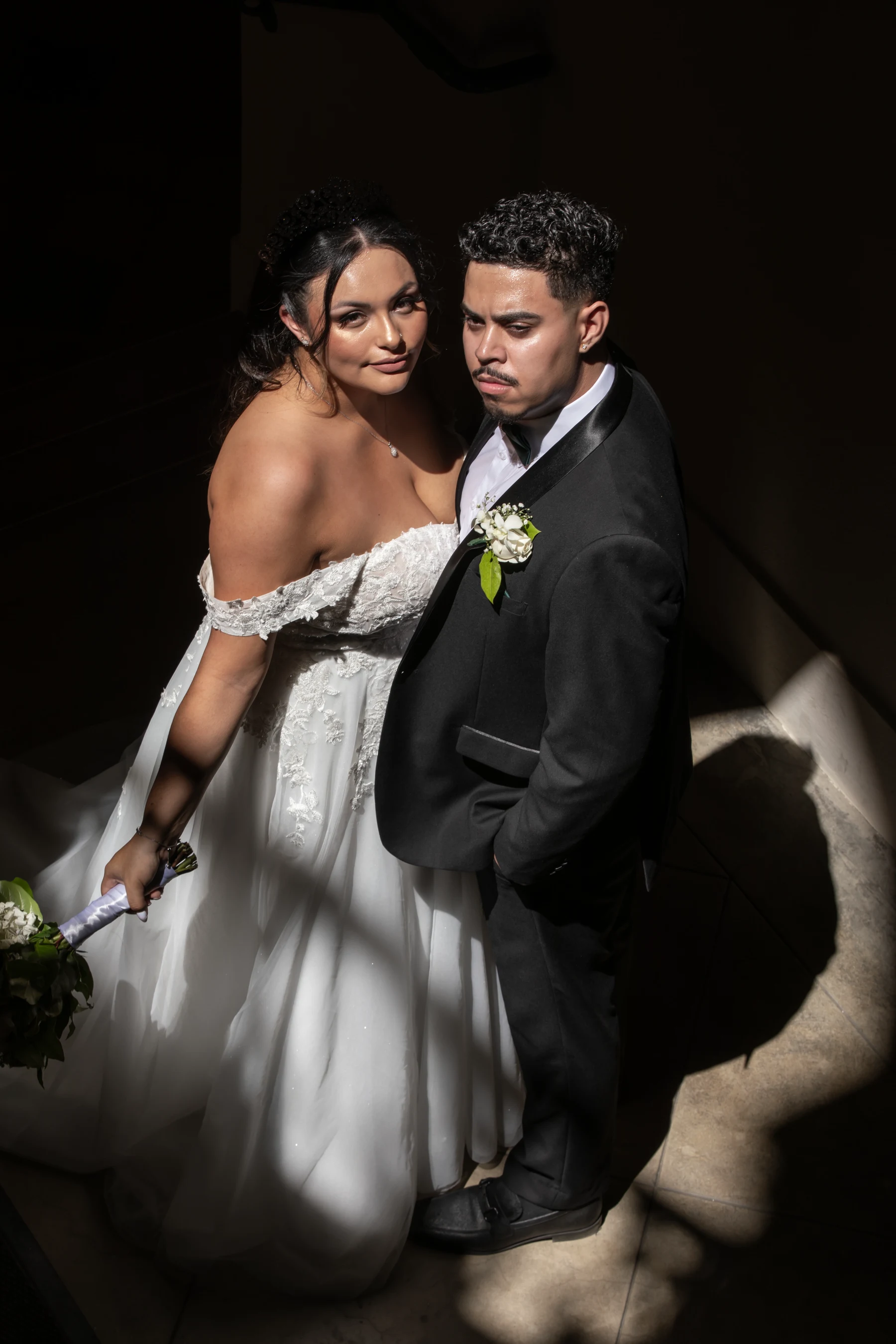
I've been shooting weddings in Los Angeles for 17 years, and if you asked me for tips for shooting wedding photography over coffee, I wouldn't hand you a list of camera settings. Settings matter, but they're maybe 20% of the job. The other 80% is anticipation, light, people skills, and staying calm when a ceremony starts 40 minutes late and you've lost your golden hour. So this is the honest version — the stuff I actually wish someone had drilled into me before my first Malibu wedding.
Shoot the light, not the moment
Rookie instinct is to chase moments. Bride laughing, dad tearing up, first kiss. You grab it, but the background is a blown-out sky and there's a shadow cutting across her face like a diagonal line. Beautiful moment, unusable frame.
I flipped my thinking years ago: I read the room for light first, then I wait for the moment to walk into it. At a rooftop reception in Downtown LA around 5 p.m. in summer, the west-facing edge of the deck gets this brutal, flat sun that turns everyone into a squint. But the shaded side, backlit against the skyline, is magic. I'll physically position myself there and let people come to me.
Golden hour in LA is not a fixed thing. At a Palos Verdes cliffside in June, the good light lingers until almost 8 p.m. In December at the same spot, you're done by 4:45. I'll be blunt: most couples plan their timeline around the caterer, not the sun, and photographers who don't push back on that end up shooting portraits in the dark with a flash. Know your sunset time cold and build the day around it.
Anticipation beats reflexes
You cannot react your way through a wedding. By the time you see the tear, it's gone. The photographers who nail the emotional frames are the ones who know what's coming before it happens.
During the ceremony, I watch the parents, not just the couple. When the groom's mom's chin starts to quiver, I'm already on her. During the vows, I keep one eye on the person listening, because the reaction is usually better than the person talking. This is also exactly why I tell couples a second shooter earns their keep — one of us on the readers, one on the couple, and you miss nothing.
Learn the beats of a wedding day so well that you're bored by the structure. Getting ready, first look, ceremony, cocktail hour, reception, toasts, first dance, exit. When the rhythm is muscle memory, your brain is free to notice the unscripted stuff — the flower girl faceplanting, the grandfather sneaking a dance. Those are the frames people actually cry over ten years later.
Camera settings I actually use
Here's my real-world approach, not a textbook one.
- Shoot in manual, but let ISO float. I keep my aperture and shutter where I want them creatively and let auto ISO handle the swings. Walking from a dim getting-ready suite in a Beverly Hills hotel out into blazing courtyard sun, you don't have time to chimp exposure. If you're on the fence about this, I wrote a whole piece on whether auto ISO belongs at a wedding.
- Shutter speed floor of 1/200 for people. Kids and dancing need 1/500 or faster. Blurry hands during the first dance are the number one thing that ruins otherwise great reception frames.
- Shoot wide open, but not always. f/1.4 looks dreamy for a single portrait. For a group of eight family members standing on slightly different planes, you'll have half the faces soft. I close down to f/4 or f/5.6 for anything with more than three people.
- Always RAW. LA venues throw mixed lighting at you constantly — warm string lights, cool moonlight, a purple uplight from the DJ. RAW is what lets you fix that later instead of delivering someone with a green face.
Learn to actually talk to people
Most photographers won't say this, but your camera skills matter less than whether people relax around you. A nervous couple photographs nervous. Stiff shoulders, tight smiles, hands that don't know where to go.
I spend the first ten minutes of every shoot just talking. No posing yet. Where'd you two meet, who cried at the proposal, that kind of thing. By the time I lift the camera, they've forgotten it's there. When I do direct people, I give small, physical cues — "shift your weight to your back foot," "whisper the worst thing you can think of to her" — because "look natural" is the most useless instruction in photography. If posing feels intimidating, I broke down my whole approach in this piece on posing that doesn't look posed.
Protect yourself from disaster
I've seen a card fail at a Pasadena wedding. Not mine — a colleague's, and it was gutting to watch. Here's what I refuse to compromise on:
- Dual card slots, always. Every frame writes to two cards simultaneously. If you're shooting weddings on a single-slot body, you are one hardware glitch away from a lawsuit and a wedding you can never re-shoot.
- Never format on site. I don't wipe a card until it's backed up in two places at home.
- Two of everything critical. Two bodies, extra batteries, a spare flash. LA venues love to surprise you — the Ace Hotel rooftop at night is beautiful and pitch black once the sun drops.
This is also the practical case I make for running photo and film as one operation. At ConneryFilm we handle photography and cinematic video under one roof, one team on the day, which means we're never fighting another vendor for the same three feet of aisle during the first kiss. Two separate companies elbowing each other for the money shot is a real problem, and the couple is the one who pays for it in the gallery.
If it were my own wedding, here's what I'd prioritize
Honestly? I'd protect the timeline above almost everything. The single biggest predictor of good wedding photos isn't the photographer's gear — it's whether the day has breathing room. I'd build in a buffer before the ceremony, do a real getting-ready window, and I'd absolutely schedule a first look if the sunset math demanded it.
I'd also stop worrying about capturing literally everything. A frantic photographer machine-gunning 6,000 mediocre frames delivers a worse gallery than one who's present for 1,500 great ones. Slow down. Get the shot right in camera. Your future self, editing at 1 a.m., will thank you.
Frequently asked questions
What camera settings are best for shooting a wedding ceremony?
For most LA ceremonies I'm at f/2.8 to f/4, shutter no slower than 1/250, and auto ISO capped so it doesn't get grainy. In a dim church I'll open up and raise the ISO ceiling; at a bright outdoor Malibu ceremony I'll close down and drop it. The exact numbers matter less than exposing for the faces and shooting RAW so you can recover the rest.
How do you get natural, candid shots instead of stiff poses?
Talk more, direct less. Give people something to do or someone to interact with rather than telling them to "look natural." I mix quick prompts with long stretches where I just let a couple be together and shoot the in-between moments. If you want the full breakdown, I compared candid versus posed shooting in detail.
Do I need a second photographer to shoot a wedding well?
Not for every wedding, but for anything over about 80 guests or a day with tight logistics, yes. One person cannot be on the groom's reaction and the bride walking down the aisle at the same time. A second shooter also covers you if gear fails.
How many photos should I deliver from a wedding?
For a full eight-to-ten hour day, somewhere between 500 and 800 finished, edited images is normal from me. Quality over volume — I cull hard and only deliver frames I'd be proud to hang on a wall.
What's the most common mistake new wedding photographers make?
Ignoring the light and shooting reactively instead of anticipating. Second place is not having backup gear. Both are completely avoidable, and both separate someone who owns a nice camera from someone who can actually be trusted with a day that doesn't repeat.
If you're planning a wedding here in LA and you want photography and film handled by one team that's done this hundreds of times, I'd genuinely love to hear about your day. Call or text 818.749.7039, or come see the work and say hello over at ConneryFilm.com. Let's make sure your day is shot by people who see it coming before it happens.
Meet the Author: Connery Davoodian Hello, I'm Connery Davoodian, the visionary behind ConneryFilm, and I'm thrilled to share insights from my 17-year journey through the world of wedding photography and videography. My passion extends beyond simply capturing images; it's about artfully weaving your unique love story into a timeless, cinematic masterpiece. My artistic path began long before I ever picked up a camera, deeply rooted in music as a singer, songwriter, and multi-instrumentalist. This diverse background in directing, producing, and editing has cultivated a unique perspective, allowing me to approach each wedding not just as an event, but as a dynamic narrative waiting to be beautifully told. This blend of technical mastery and creative storytelling is the heartbeat of ConneryFilm, ensuring that every frame, every shot, and every film is infused with depth, emotion, and unparalleled artistic integrity. At ConneryFilm, we believe your wedding memories deserve nothing less than bespoke luxury. My philosophy centers on capturing the authentic, unscripted moments – the genuine smiles, the tender glances, the joyful laughter – that truly define your day. While we obsess over exquisite details and sophisticated aesthetics, our true joy comes from making you feel completely at ease, like a "friendor" who genuinely celebrates alongside you. This calm, organized presence allows your true personalities to shine, resulting in images and films that are as real and vibrant as your love itself. Based in the heart of Los Angeles, California, my team and I are privileged to serve couples across the globe, bringing our signature high-end wedding photography and videography to destination weddings worldwide. Through these blog posts, I aim to share invaluable insights, luxurious inspiration, and practical, fun advice to guide you through your wedding planning journey, helping you make informed decisions about preserving your most cherished moments. Thank you for trusting ConneryFilm to be a part of your extraordinary adventure. I'm excited to share my knowledge and passion with you, helping you create memories that will last forever.