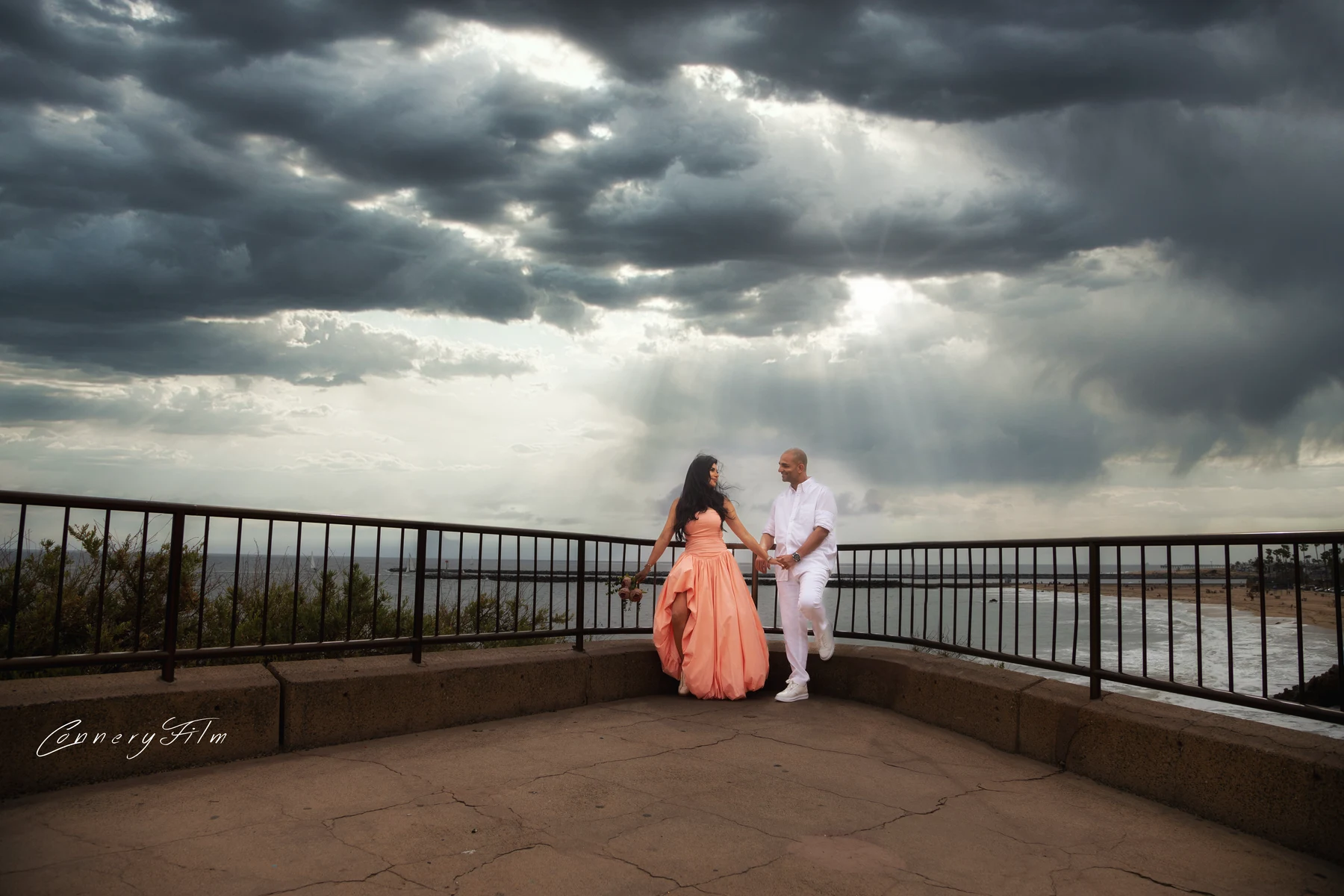
Every couple who asks me what settings to use for wedding photography expects a long answer. Here is the short one: f/2, 1/250th of a second, Auto ISO capped at 6400, back-button focus, RAW. That is where my camera sits when I walk into a getting-ready room in Pasadena at 11 in the morning, and it is where it sits again when the sparklers come out in Malibu at ten at night. The dials move maybe a dozen times across a ten-hour day. Everything else is light, timing and knowing what is about to happen three seconds before it happens.
I have been shooting weddings for 17 years. I'll be blunt: the settings question is the one that beginners obsess over and working photographers barely think about. But it does have a real answer, and nobody ever writes it down with actual numbers, so here are mine.
My default: f/2, 1/250, Auto ISO 100–6400
That trio handles roughly 80% of a wedding day. Here is the reasoning behind each one.
- f/2 — wide enough to separate a bride from a cluttered hotel room, deep enough that both her eyes land in focus when she turns her head. f/1.2 looks incredible on a static portrait and betrays you the instant somebody moves.
- 1/250 — fast enough to freeze a hug, a spin on the dance floor, a father wiping his face. Below 1/200 you start losing frames to motion you did not see in the viewfinder.
- Auto ISO, 100 floor, 6400 ceiling — the camera handles the one variable that changes every 30 seconds. I wrote a whole piece on how I set Auto ISO for weddings, because it is the single change that improved my keeper rate most.
Manual aperture, manual shutter, automatic ISO. Photographers call this manual with Auto ISO, and it is what most working wedding shooters in Los Angeles actually run, whatever they say on Instagram.
Aperture: why I live at f/2, and the three times I don't
Shooting wide open is a habit people pick up from portfolios, where every image is one person standing still. A wedding is not that. I open up to f/1.4 for maybe fifteen frames a day — ring detail, a dark ceremony from the back, one hero portrait — and stop down the rest of the time.
Three situations where f/2 is the wrong call:
- Two or more people at different distances. Family formals go to f/5.6, and if I have three rows of relatives on the steps of a Glendale church, f/8. Missing Grandma's face because you wanted creamy bokeh is unforgivable and it happens constantly.
- Anything moving toward the camera. The aisle exit, the first dance, the grand entrance. f/2.8 buys you a few extra inches of depth and turns a 60% hit rate into a 90% one.
- Bright midday sun. A noon ceremony in Calabasas or a rooftop in Downtown puts me at f/4 with an ND filter, not f/1.4 at 1/8000. Wide open in harsh light gives you nothing but a thinner slice of focus and clipped highlights.
Shutter speed: 1/250 is the number, and here is the floor
People quote the old reciprocal rule — 1/focal length — and then wonder why a third of their reception is smeared. That rule was about your hands shaking. It says nothing about your subject moving, and at a wedding your subject is always moving.
My real floors:
- Ceremony, people seated: 1/200
- Aisle walk, first look, hugs: 1/250
- Dance floor, bouquet toss, kids running: 1/400 to 1/500
- Absolute emergency floor in a very dark church: 1/125, and I brace against a pew
I would rather deliver a slightly noisier photo at 1/400 than a clean blurry one at 1/60. Noise at ISO 12800 on a modern body cleans up in about four seconds. Motion blur is permanent. That trade is not close.
ISO: pick your ceiling once, then stop thinking about it
My cap is 6400 for most of the day. When the DJ kills the lights I push the ceiling to 12800 and leave it there. Full-frame bodies made in the last five or six years are genuinely fine at 12800 — the grain reads as texture, not as a mistake, and it disappears in Lightroom.
The bigger point: your ISO cap is a decision you make twice a day, not a dial you spin per frame. Set it in the morning, raise it at the reception, and spend the attention you save watching the room. I have written before about how camera settings are maybe 20% of wedding photography, and the other 80% is anticipation. Every second spent on the back of the camera is a second you are not watching the groom's mother.
Four Los Angeles scenes and exactly what I dial in
Generic advice falls apart the moment you are actually standing in the room. So here is the day, scene by scene, with numbers.
Getting ready, 11am, hotel suite in Beverly Hills. I kill every lamp in the room and shoot only by the window. f/2, 1/250, ISO usually lands 400–1600. Mixed tungsten and daylight is the number one reason getting-ready photos come back looking orange and green, and the fix is a light switch, not a slider.
Ceremony, 4pm, outdoor courtyard in Pasadena. Dappled shade under trees is the hardest light at any wedding — the exposure difference between a sunlit cheek and a shaded one is three stops. I expose for the highlights, meter off the bride's dress, and let the shadows fall. f/2.8, 1/500, ISO 100–400. A blown white dress cannot be recovered; a dark shadow can.
Portraits, golden hour, Malibu bluff. Real usable golden light in LA runs about 25 minutes, not an hour — I go into this in detail in my piece on timing outdoor weddings around the light. Backlit, sun behind their heads, f/2, 1/1000, ISO 100. I expose for their faces and let the background blow out. That is the shot people frame.
Reception, 9pm, DTLA loft. Off-camera flash on a stand behind the dance floor, on-camera bounce as fill. f/2.8, 1/200, ISO 3200–6400, flash at about 1/8 power. Dragging the shutter a bit keeps the string lights and the DJ's uplighting alive in the frame instead of turning the background into a black hole.
The settings nobody asks about that matter more
Aperture and shutter get all the questions. These get none, and they cause more ruined galleries:
- RAW, always. Two cards, written simultaneously. Not RAW+JPEG to one slot. Two physical cards recording the same frames. A card fails maybe once every few years, and when it does you need the second one to exist.
- Back-button focus, continuous AF, eye detect on. Separating focus from the shutter means a recomposed frame does not refocus on the wall behind them.
- Auto white balance, corrected in post. Modern AWB is excellent and you are shooting RAW anyway. I only override it under stage lighting or heavy uplighting.
- Highlight-weighted or -1/3 exposure compensation. Recovering shadows is easy. A clipped white dress is gone forever.
- Silent shutter during vows only. Not all day — rolling shutter warps a spinning dancer — but during a quiet ceremony, absolutely.
What I'd tell you if you were shooting your own wedding
Honestly? I would tell you to stop reading settings articles and go shoot in bad light on purpose. Photograph a friend in a dim restaurant. Photograph a kid running across a lawn. Shoot the worst-lit room in your house until you know, without checking, that it is an ISO 3200 room.
Most photographers won't say this, but the reason my settings are boring and static is that consistency is worth more than optimization at a wedding. A locked-in setup you never think about frees your entire brain for the thing that actually makes the photo: seeing the moment coming.
It is the same logic behind how I run ConneryFilm. We shoot photography and cinematic film under one roof — same team, same day, one plan — because two vendors negotiating over where to stand during the vows costs you moments that no camera setting recovers. Fewer moving parts, more attention on the couple.
Common questions about wedding camera settings
What ISO is too high for a wedding?
On a full-frame body made in the last five years, nothing under 12800 worries me, and I will go to 25600 at a dark reception rather than drop below 1/200. Noise is fixable in editing. Blur is not.
Should I shoot weddings in manual or aperture priority?
Manual aperture and shutter with Auto ISO. Aperture priority gives up control of your shutter speed, which is the one setting that decides whether a moving moment is sharp. Full manual makes you chase changing light instead of watching the room.
What shutter speed do I need for the first dance?
1/200 minimum with flash, 1/400 without. Dancing looks slower than it is — a spin that feels gentle across a dance floor is easily a full stop faster than your instinct says.
Do I need f/1.4 lenses to shoot weddings?
No. An f/2.8 zoom and a decent flash will out-deliver an f/1.4 prime at a real wedding, because most of your frames need depth of field and most of your problems are light you have to add, not light you have to gather.
What settings should a second shooter use?
Match the lead's shutter and ISO ceiling so the two galleries edit consistently, but shoot a stop deeper — f/2.8 to f/4 — since second-shooter angles are usually wider and further back.
If you are planning a Los Angeles wedding and you would rather talk about your day than about f-stops, I would genuinely love to hear about it. Tell me your venue and your timeline and I will tell you honestly how the light will behave and what your day needs. Call or text 818.749.7039, or see recent work at ConneryFilm.com — photography and film, one team, one seamless day.
Meet the Author: Connery Davoodian Hello, I'm Connery Davoodian, the visionary behind ConneryFilm, and I'm thrilled to share insights from my 17-year journey through the world of wedding photography and videography. My passion extends beyond simply capturing images; it's about artfully weaving your unique love story into a timeless, cinematic masterpiece. My artistic path began long before I ever picked up a camera, deeply rooted in music as a singer, songwriter, and multi-instrumentalist. This diverse background in directing, producing, and editing has cultivated a unique perspective, allowing me to approach each wedding not just as an event, but as a dynamic narrative waiting to be beautifully told. This blend of technical mastery and creative storytelling is the heartbeat of ConneryFilm, ensuring that every frame, every shot, and every film is infused with depth, emotion, and unparalleled artistic integrity. At ConneryFilm, we believe your wedding memories deserve nothing less than bespoke luxury. My philosophy centers on capturing the authentic, unscripted moments – the genuine smiles, the tender glances, the joyful laughter – that truly define your day. While we obsess over exquisite details and sophisticated aesthetics, our true joy comes from making you feel completely at ease, like a "friendor" who genuinely celebrates alongside you. This calm, organized presence allows your true personalities to shine, resulting in images and films that are as real and vibrant as your love itself. Based in the heart of Los Angeles, California, my team and I are privileged to serve couples across the globe, bringing our signature high-end wedding photography and videography to destination weddings worldwide. Through these blog posts, I aim to share invaluable insights, luxurious inspiration, and practical, fun advice to guide you through your wedding planning journey, helping you make informed decisions about preserving your most cherished moments. Thank you for trusting ConneryFilm to be a part of your extraordinary adventure. I'm excited to share my knowledge and passion with you, helping you create memories that will last forever.