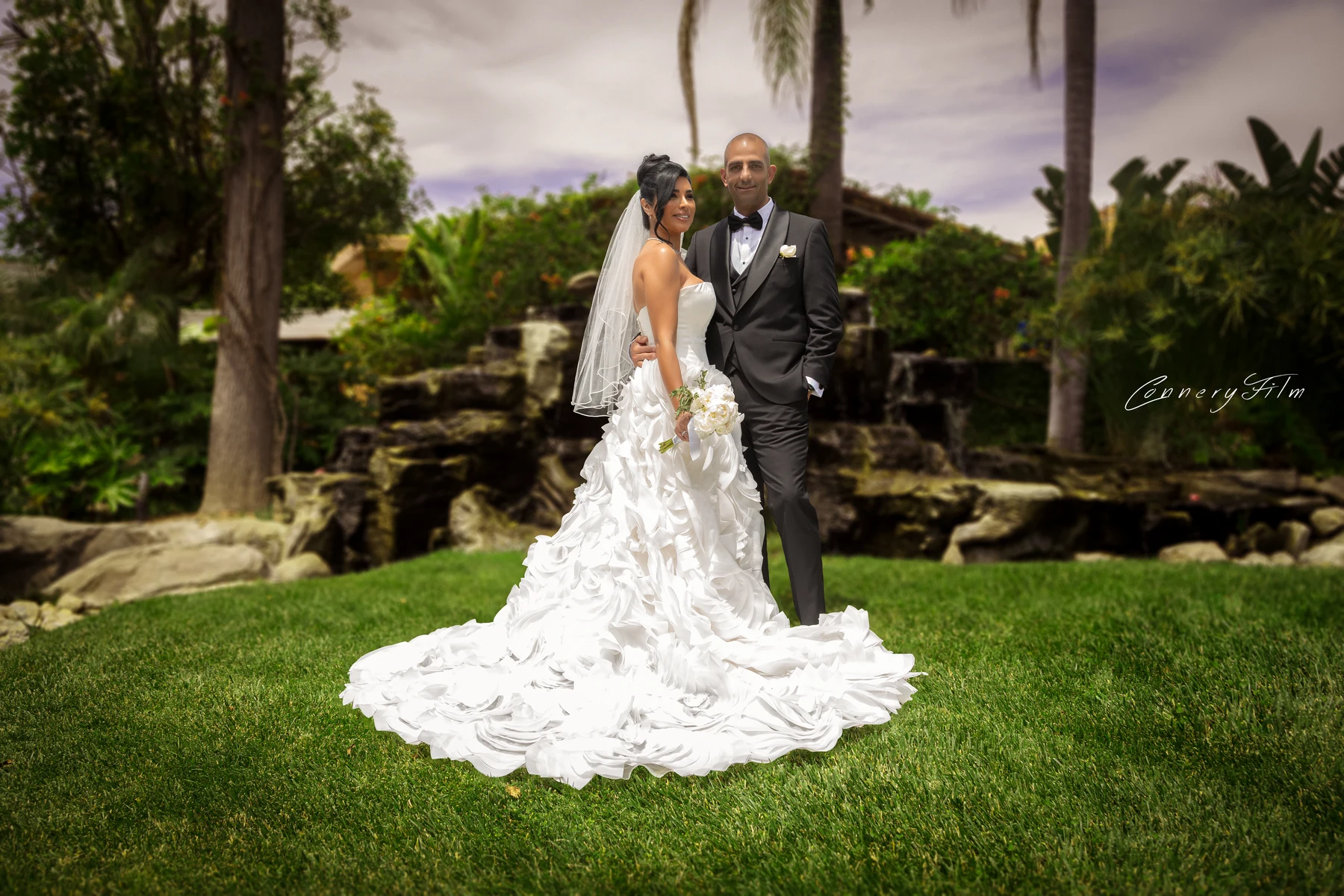
Hollywood Wedding Photographer & Cinematographer
I'm Connery Davoodian. I've spent 17 years photographing and filming weddings across Los Angeles, and Hollywood is one of the trickiest patches of the city to shoot well. Not because the venues are bad — some of them are gorgeous — but because Hollywood weddings live in two opposite worlds. Half the day is a historic house with real windows and gardens. The other half is a windowless event room with hard, colored uplighting that will wreck your skin tones if nobody plans for it. If you're getting married anywhere between Lombardi House and East Hollywood, the single most important thing your photographer and videographer bring isn't a camera. It's a lighting plan.
Why Hollywood is different to shoot
Drive through Hollywood and East Hollywood on a wedding Saturday and you'll pass two completely different kinds of venue on the same block. There are the historic houses — Craftsman and Victorian bones, big porches, ivy, west-facing lawns that go golden right at dinner. And then there are the ballrooms and event halls, built for volume, often with almost no natural daylight once you're past the lobby. I've shot rooms in this neighborhood where the only light after 6pm is whatever the DJ's uplighting and the venue chandeliers are throwing at you. That's fine — if you know it's coming and you bring light with you. It's a disaster if you assumed you'd shoot the way you would on a Malibu lawn.
This is the whole reason I care so much about timing here. LA golden hour lasts about 25 minutes, and in Hollywood that window is often the only good natural light you'll get all evening. If your ceremony runs late and eats that light, we're shooting your couple's portraits under tungsten and gel. So when I build a timeline for a Hollywood wedding, I'm protecting that daylight like it's money. Light and timing beat gear every single time, and nowhere is that more true than in these rooms.
The venues I actually know here
Taglyan Complex — This is a mainstay of Armenian celebrations in Los Angeles, and I've shot enough of them to know the building. It's a luxury ballroom with a manicured garden entrance, and the in-house team runs a tight operation. The garden is where you get your daylight and your greenery; the ballroom is where you commit to flash and a real lighting setup, because the room is built to control its own light, not to give you any. If you're planning a big Armenian wedding here, plan your portraits around that garden while the sun's still up.
Yamashiro — The hilltop pagoda above Franklin. The view over Hollywood at dusk is one of the best in the city, and the garden and koi ponds photograph beautifully. The catch is access and timing: it sits up a narrow road, parking and load-in take longer than people expect, and the good exterior light disappears fast once the sun drops behind the ridge. I get portraits done here before the last of the light goes, then move inside.
Lombardi House — I've photographed and filmed this one in full. It's a white Victorian farmhouse in the middle of Hollywood with a working lawn and citrus trees, which is a rare thing this close to Sunset. It's an outdoor-forward property, so the day flows with the light — great early, great at that golden window, and then you're leaning on your own lighting once it's dark. It's one of my favorite houses in the neighborhood to shoot because it gives you a garden wedding feel a block from the city.
The Vermont Hollywood — I've also covered this venue end to end. It's more of an event-space feel than a historic house, and it's a good example of an East Hollywood room where the light is whatever you make it. This is a bring-your-own-light building. On a night wedding here, the difference between flat and cinematic is entirely on the photographer and the film team, not the room.
The Garland in North Hollywood, just over the hill, has forty-plus years of weddings behind it and a genuine garden — an easier, greener day than most Hollywood proper venues. And the Universal City hotels right above the 101 are a practical base for a lot of my couples: rooms with real windows for getting ready, close to the ceremony, and a short drive that keeps you out of the worst of the Cahuenga Pass traffic. On that note — build extra buffer into any Hollywood timeline. The 101, Highland, and Franklin all seize up, and a late shuttle eats your daylight.
How I handle the dark rooms
In the hard-lit Hollywood ballrooms I shoot fast and I shoot with intent. I run auto ISO with a floor and a ceiling so I'm not chasing exposure while your first dance is happening, and I light people rather than letting the room's colored uplighting paint everyone magenta. On the film side, the crew is lighting for motion at the same time — which is the real advantage of hiring one team for both. Photography and cinematography come from the same crew here, not two vendors elbowing each other for the same corner. In a small, dark Hollywood room, that coordination is the difference between usable footage and two teams fighting over one good angle.
One blunt opinion: if a photographer tells you they shoot these rooms "all natural light," walk away. There is no natural light in a windowless Taglyan-style ballroom at 9pm. "Natural light only" in Hollywood means underexposed, noisy photos of the most expensive party of your life. You want someone who owns lights and knows how to make them look like they were always there.
A word on permits and logistics
Most Hollywood venues handle the permitting internally, but if you're stealing engagement portraits at a public garden or a landmark, the rules matter — some LA gardens require a permit for wedding photos, and staff will stop an unpermitted shoot. And every real venue here will ask your vendors for proof of coverage before they let anyone in — venues won't let photographers shoot uninsured, so make sure whoever you hire actually carries it.
Frequently asked questions
Do I need a second shooter for a Hollywood wedding?
Not always. In a dark, compact ballroom a second set of hands earns its place, especially for capturing reactions while I'm on the couple. But for a smaller house wedding at Lombardi House, one photographer plus the film side is often plenty. I'll tell you honestly which one your day needs.
When should I book?
For the popular Hollywood venues — Taglyan especially during Armenian wedding season — book early. I generally tell couples to lock a photographer 9 to 14 months out. The best dates at these rooms go first.
How do we protect the good light?
We build the timeline backwards from sunset. I want your couple's portraits inside that golden window before the room goes dark, which usually means a first look or a tight post-ceremony plan. Give me the daylight and I'll give you the photos everyone actually frames.
Can you do both photo and video?
Yes — that's the whole point of ConneryFilm. One team, one plan, one lighting setup that serves both the stills and the film. In Hollywood's tight rooms that's not a luxury, it's how you avoid two crews ruining each other's shots.
If you're getting married in Hollywood or East Hollywood and you want someone who already knows how these rooms behave, let's talk about your day. Call or text (818) 749-7039 or reach me through the contact page, and tell me your venue and date. I'll tell you straight what your timeline and light will actually allow.