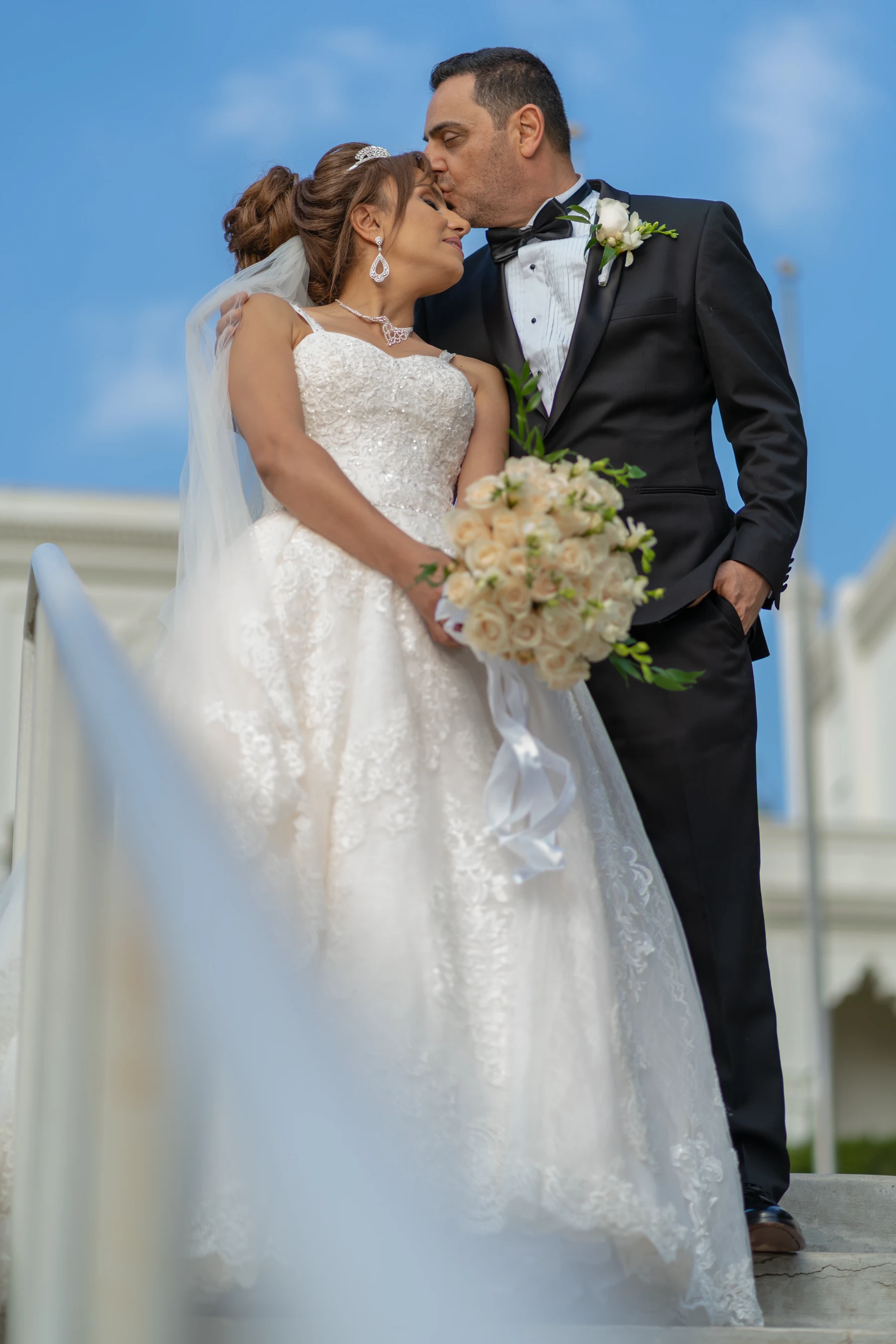
Almost every couple who asks me why wedding photos come out overexposed is holding the same evidence: a photo of themselves at 2pm outdoors, where the sky is a flat white sheet, the veil has no lace in it anymore, and the bride's white dress has turned into a glowing blob with no seams. That is not a mystery. That is Los Angeles sun at midday plus a camera that was told to average the scene, and it happens to good photographers on bad days and to bad photographers on every day.
I have been photographing and filming weddings here for 17 years, and I will be blunt about the thing most photographers won't say out loud: an overexposed wedding photo is almost never the camera's fault. It's a decision, or a missing decision. Here is what actually causes it, what can be recovered, and what cannot.
The short answer: your camera is trying to average a scene that has no average
A camera's meter wants to make everything it sees middle grey. Point it at a white dress in direct Malibu sun with a dark tuxedo next to it and a bright sky behind, and there is no single exposure that makes all three correct. The meter splits the difference, and the brightest thing in the frame — the dress, the sky, the white pergola at the Hotel Bel-Air — goes past what the sensor can record. Once a highlight hits pure white, there is no data left in it. It is not dim. It is empty.
That's the part couples don't realize. A dark photo has information hiding in it. A blown-out photo has a hole. You can lift shadows two stops in Lightroom and the photo looks fine. You cannot bring back a dress that recorded as 255, 255, 255, because nothing was written to the file.
Cause 1: shooting at the wrong hour and not compensating
Los Angeles sun between roughly 11am and 3pm from May to September is brutal, high, and contrasty. It comes almost straight down, which puts a black shadow under the brow and nose and a hot rim on the shoulders. Couples book a 1pm first look at a Pasadena estate because that's what fit the timeline, and then wonder why the pictures look harsh and hot.
The professional answer isn't a better camera. It's moving. Open shade, backlight, a north-facing wall, the shadow line of a building — those are what I hunt for the moment I arrive. I've written before about how golden hour here lasts about 25 minutes, and that's exactly why I build portrait time around the light instead of the other way around. If you're planning a summer wedding in the Valley, ask your photographer what they'll do at 1pm. If the answer is vague, that's the answer.
Cause 2: metering off the wrong thing
Aim an evaluative meter at a bride in a white gown against a dark hedge at Greystone Mansion and the camera sees mostly dark, so it opens up — and cooks the dress. Aim it at a dark suit against a bright sky and it closes down, so the faces go muddy while the sky looks fine.
What I do instead: I expose for the brightest thing I care about keeping — usually the dress or the skin — and let the rest fall where it falls. Highlights get protected. Shadows get lifted later. On modern full-frame bodies I have four or five usable stops underneath and maybe one and a half above, so I bias down. I keep the highlight alert on, I watch the histogram between setups, and I dial exposure compensation to roughly minus two-thirds of a stop as a working default outdoors in bright sun. My general settings for LA weddings assume that bias built in.
Cause 3: auto modes with no ceiling on them
Full auto and unsupervised auto ISO cause a lot of the overexposed frames I see in other people's galleries. The camera walks from a dim getting-ready room at the Beverly Wilshire out into a courtyard, and the settings lag behind for two or three frames — which happens to be exactly when the door opens and the bride walks out. Those are the frames people actually want.
Auto ISO is not the villain here; I use it at weddings all day. But I cap it, I fix my shutter and aperture, and I ride exposure compensation with my thumb as I walk between light. Unmanaged automation is what produces a gallery where the ceremony looks great and the exit looks like a lightning strike.
Cause 4: the venue's own lighting fighting the sun
Half of LA's most-booked spaces are indoor-outdoor. A reception at a Santa Monica rooftop at 6:30pm has warm string lights, a bright western sky, and a DJ throwing 6000K white LED at the dance floor. That white LED is the quiet killer. It spikes one channel, usually blue, and even if the overall exposure is fine, the faces on the dance floor clip in a way that looks weirdly plastic and can't be pulled back.
The fix is flash — small, controlled, mixed in — not a bigger ISO. I'd rather add my own light and drop the ambient than let the room's lighting rig decide what my photos look like. If a photographer tells you they never use flash under any circumstances, ask what happens at 9pm in a dark ballroom or under colored uplighting. There's a real answer, and "natural light only" isn't it.
Cause 5: it wasn't overexposed, it was edited that way
Here's the one nobody wants to hear. A significant share of the "overexposed" wedding photos couples send me were exposed fine and then pushed in editing — the light-and-airy look taken too far, a preset applied to a whole gallery, whites raised, blacks lifted, contrast pulled out until the whole thing looks washed and hazy.
Honestly, I think this is the more common problem now. It's a style, and some people genuinely love it. But it's a choice being made after your wedding, on your photos, and you should know which look you're buying before you sign anything. Ask to see a full gallery, not a highlight reel, and look at the whites specifically: is there detail in the dress, or is it a shape?
What can actually be recovered
- Half a stop to a stop hot in a RAW file: almost always recoverable. Detail is still there.
- A blown sky behind a properly exposed couple: often fine, sometimes intentional. A white sky is not a ruined photo.
- Two or more stops over on skin or a dress: gone. Editing will produce grey mush where the texture was.
- Shot in JPEG instead of RAW: you have maybe a third of the recovery latitude. This is one of the questions worth asking before you book.
This is also where shooting photo and film with the same team helps in a way that isn't obvious. At ConneryFilm we run photography and cinematography under one roof, so my photographer and my cinematographer are reading the same light at the same moment and lighting for both — instead of a video crew slapping a hard LED panel on a stand three feet from a bride while my stills shooter fights it. Two vendors who met that morning don't coordinate light. One team does.
What I'd tell you if this were your wedding
Build your timeline around light before you build it around anything else except the ceremony start. Give me 20 minutes at sunset. Don't put formal portraits at high noon in an unshaded courtyard in Woodland Hills in July and expect them to look like the ones you pinned. And hire someone whose full galleries — the whole day, not the ten best frames — hold detail in the whites. Light and timing beat gear, every time.
Common questions about overexposed wedding photos
Can my photographer fix overexposed photos after the wedding?
Partially. If the file is RAW and the highlights are less than about a stop over, yes, and you'll never know. If the dress or skin clipped completely to white, no editing recovers it, because there is no detail in the file to recover.
Is it my fault for scheduling photos at midday?
No. A working LA photographer should be able to handle 1pm sun with shade, backlight, scrims or flash. Timing makes the job easier, but midday is not an excuse for blown-out photos.
Do overexposed photos mean my photographer is inexperienced?
A few hot frames across a 700-image gallery is normal — fast-moving moments happen and you'd rather have the moment than a perfect histogram. A pattern of blown highlights across whole sections of the day is a skill problem.
Should I ask for a reshoot?
If a meaningful portion of the gallery is unusable, raise it with your photographer first and in writing. Reshoots of portraits are a real option in LA and typically run $600 to $1,500 for a session; the ceremony itself obviously can't be redone.
Does "light and airy" mean overexposed?
Not necessarily. Done well it's a bright, low-contrast edit that still holds detail in whites. Done badly it's a global exposure push that flattens everything. Look at a full gallery and judge the dress.
If you're planning a wedding in Los Angeles and you want photos that hold up in bright sun and dark ballrooms alike — with photography and cinematic film handled by one team who plan the light together — I'd love to hear about your day. Call or text 818.749.7039, or come see recent work at ConneryFilm.com.
Meet the Author: Connery Davoodian Hello, I'm Connery Davoodian, the visionary behind ConneryFilm, and I'm thrilled to share insights from my 17-year journey through the world of wedding photography and videography. My passion extends beyond simply capturing images; it's about artfully weaving your unique love story into a timeless, cinematic masterpiece. My artistic path began long before I ever picked up a camera, deeply rooted in music as a singer, songwriter, and multi-instrumentalist. This diverse background in directing, producing, and editing has cultivated a unique perspective, allowing me to approach each wedding not just as an event, but as a dynamic narrative waiting to be beautifully told. This blend of technical mastery and creative storytelling is the heartbeat of ConneryFilm, ensuring that every frame, every shot, and every film is infused with depth, emotion, and unparalleled artistic integrity. At ConneryFilm, we believe your wedding memories deserve nothing less than bespoke luxury. My philosophy centers on capturing the authentic, unscripted moments – the genuine smiles, the tender glances, the joyful laughter – that truly define your day. While we obsess over exquisite details and sophisticated aesthetics, our true joy comes from making you feel completely at ease, like a "friendor" who genuinely celebrates alongside you. This calm, organized presence allows your true personalities to shine, resulting in images and films that are as real and vibrant as your love itself. Based in the heart of Los Angeles, California, my team and I are privileged to serve couples across the globe, bringing our signature high-end wedding photography and videography to destination weddings worldwide. Through these blog posts, I aim to share invaluable insights, luxurious inspiration, and practical, fun advice to guide you through your wedding planning journey, helping you make informed decisions about preserving your most cherished moments. Thank you for trusting ConneryFilm to be a part of your extraordinary adventure. I'm excited to share my knowledge and passion with you, helping you create memories that will last forever.