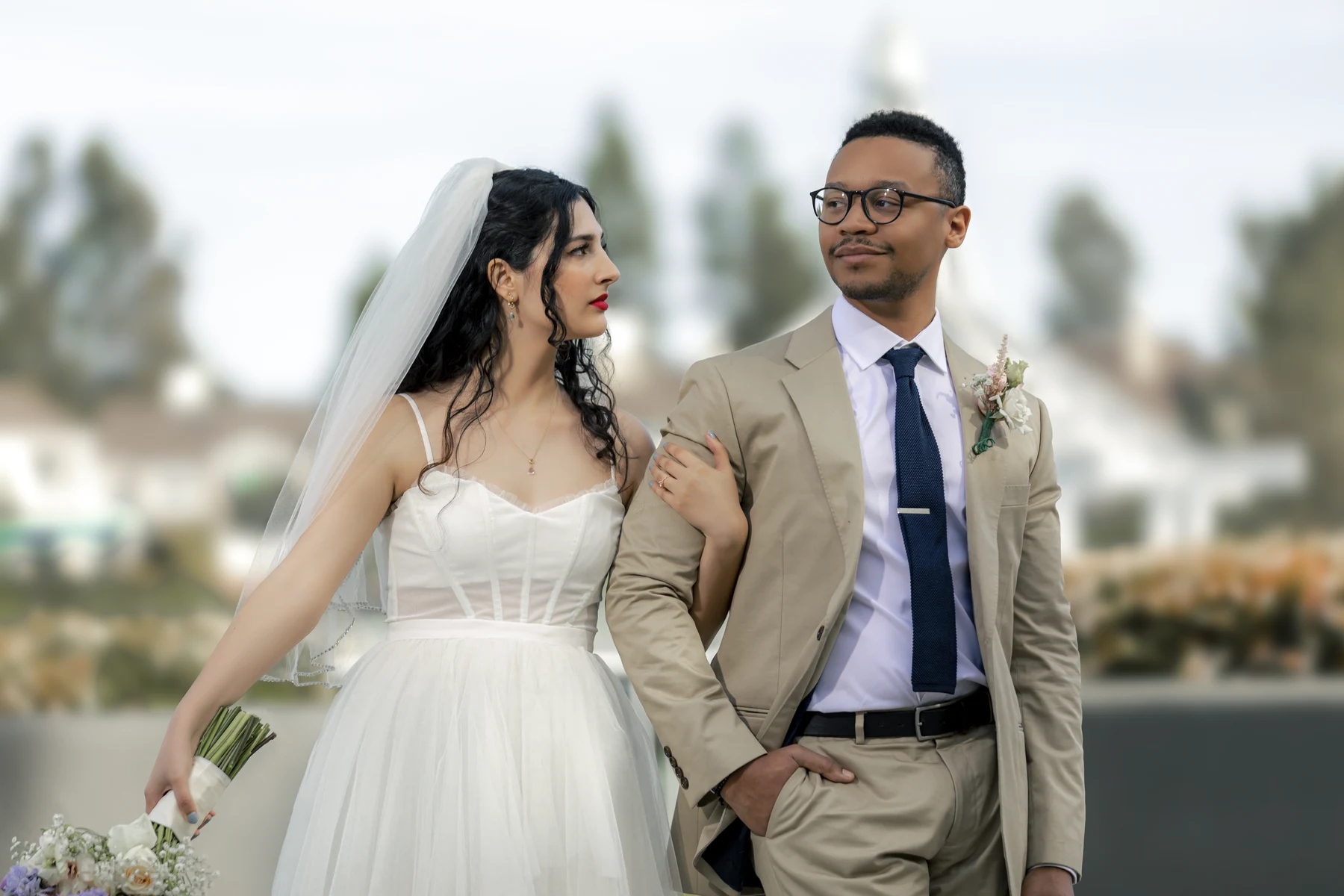
When a couple emails me asking for wedding videography examples, what they usually mean is "prove it." Fair. Anyone can put twelve slow-motion seconds of a veil on Instagram and call themselves a cinematic filmmaker in Los Angeles. So instead of handing you a reel and hoping you're impressed, I'm going to tell you exactly which five films to ask every videographer for, what each one is supposed to look like, and the specific things I'd be watching for if I were the one hiring.
I've been shooting weddings here for 17 years — Malibu bluffs, downtown lofts, backyard receptions in Encino, hotel ballrooms in Beverly Hills. The examples that actually predict whether you'll love your film are almost never the ones sitting at the top of a homepage.
The blunt version: a 90-second reel proves nothing
I'll be blunt, because this is the part most videographers won't say out loud. A highlight reel is a greatest-hits cut. It is assembled from the best four seconds of a hundred weddings. It tells you the person owns a camera, has a colorist's eye, and can buy a music license. It does not tell you whether they can hold focus during a first dance in a dark room, whether they got clean audio on the vows when the officiant's lav battery died, or whether they can deliver a finished film in under six months.
Every real answer to "what do your wedding videography examples look like?" involves watching something long and unglamorous. Which brings me to the list.
1. A full highlight film from a wedding like yours
Not a reel — a complete 3-to-8-minute highlight film from one single wedding, start to finish. And "like yours" matters more than people expect. A film shot at a golden-hour Ojai ranch tells you nothing about how someone handles a 6:30 PM December ceremony at a Pasadena estate where the sun is gone by 4:50.
Ask for a wedding that matches at least two of these: your venue type (indoor/outdoor), your season, and your guest count. If they've shot 40 weddings a year in Los Angeles, they have one. If they hedge and send you something from Santa Barbara in June when you're getting married in a downtown loft in January, that's information too.
What I watch for: does the film have a shape? Does it build, land somewhere, and end — or is it four minutes of beautiful disconnected shots set to a song? The second one is a mood board. The first one is a film.
2. The raw ceremony edit — all of it
This is the example that separates working professionals from people with a nice camera, and it's the one couples almost never ask for. Request the full ceremony cut from a real wedding. Twenty-two minutes, thirty-five minutes, whatever it ran.
Here's why. A highlight film hides everything. A full ceremony can't. You'll immediately hear whether the vows are clean or whether you're listening to a camera's built-in microphone from 30 feet back with an air conditioner humming underneath. You'll see whether there were two angles or one, whether the camera drifted out of focus during the ring exchange, whether someone had to physically move mid-ceremony and left a shaky pan in the middle of your grandmother's reading.
Audio is the thing couples never think about and always notice later. A gorgeous, out-of-focus shot is a shame. Inaudible vows are a hole in your wedding that never gets filled. On my weddings, the groom or officiant wears a lav, there's a recorder on the ceremony PA when there is one, and a backup mic on a stand — three sources, because two fail more often than you'd think.
3. A reception at night, in a hard room
Los Angeles has a particular problem: the light is spectacular until about 7 PM, and then it's uplighting and a DJ's LED wash. That's when weak videographers fall apart.
Ask for a reception cut — first dance, toasts, the dance floor — from an evening event. Watch the faces. Are they orange? Magenta? Is there so much noise in the shadows that the room looks like it was filmed through gauze? Can you hear the best man's toast, or just the room's reverb?
I'd rather show a couple this than a sunset shot. Anyone can shoot 6 PM in Malibu. Filming a toast at 9:15 PM in a windowless San Fernando Valley banquet room and making it look intentional is the actual job.
4. A film delivered in the last 90 days
Portfolios lag reality. The reel on someone's site might be three years old, shot with a second shooter who's since moved to Austin, edited by an editor they no longer use. Ask specifically: "What's the most recent film you delivered? Can I see it?"
Two things come out of that question. First, you see their current work and their current team. Second — and this is the sneaky part — you learn something about their turnaround. If the most recent delivered film is from a wedding eleven months ago, they have a backlog problem. Wedding video generally takes 8-12 weeks for a highlight film in this market, longer for full documentary edits. Anything past five or six months without a stated reason is a red flag, and I've had couples come to me after being ghosted for a year by someone who took their money in June.
5. A film where the day went wrong
This is my favorite question to be asked, and almost nobody asks it. "Show me a wedding where something went badly — rain, a two-hour delay, a venue that wouldn't let you move."
Because that's the real skill. In Los Angeles it's rarely rain; it's a ceremony starting 50 minutes late so your golden hour portraits are now blue hour, or a church that won't let a camera past the back row, or a June Gloom marine layer that never burns off in Palos Verdes. What did they do? Did the film still work?
Honestly, I think this single example tells you more than the other four combined. Anyone can make a perfect day look good. A professional makes a broken timeline look intentional.
What I'd actually do if I were hiring
Here's the shortcut version, in order:
- Watch one full highlight film before you watch any reel. If you're bored at the 90-second mark, you'll be bored at your own.
- Put on headphones. Half of what you're judging is sound, and laptop speakers hide everything.
- Ask who shot it and who's shooting yours. Studios book out. The person whose work you loved may not be the person in your ballroom. Get the name in the contract.
- Look for people who look comfortable. Stiff couples on camera usually means a filmmaker who doesn't direct. The most natural-looking footage is quietly directed the whole way through.
- Check the ending. Weak films fade out on a drone shot because there's nothing left to say. Strong ones end on a moment.
If you want the deeper list of things to raise on the call, I wrote out the questions I'd ask a wedding videographer before signing anything — coverage hours, crew, backups, music licensing, and the ones about what happens if they get sick.
Why the word "cinematic" tells you almost nothing
Every videographer in Los Angeles uses the word. It's on every site, including mine. The difference is that for some it means a specific approach — shallow depth of field, deliberate camera movement, a story structure, real color grading, sound design under the vows — and for others it means a teal-and-orange preset dragged onto handheld footage.
You can tell them apart in about 40 seconds of any example. Cinematic work has intention in the camera movement: a push in that starts before the moment and lands on it. Preset work has movement that wanders. I broke this down further in what a genuinely cinematic wedding video actually is, and it's worth reading before you compare two quotes that look identical on paper.
The examples you should also ask a photographer for
Worth saying, since roughly half of the couples who write to me are hiring both: the same logic applies to stills. Ask for one complete gallery, not a curated 30. And if you're hiring photo and video separately, ask each vendor how they handle the other one — two teams who've never met will spend your cocktail hour negotiating who stands where.
That's a big part of why I run ConneryFilm with photography and film under one roof. One team, one timeline, one point of contact — my shooters and my camera operators plan the day together weeks out, so nobody's elbowing anybody during your first look. When couples ask me for examples, I can show them the photos and the film from the same wedding, shot by the same crew, and you can see how they were built to complement each other rather than compete for the same three feet of aisle.
Frequently asked questions
How many wedding videography examples should I watch before booking?
Three to five complete films from two or three videographers, not thirty reels from twenty. Watching one full film all the way through teaches you more than an hour of scrolling. Most couples I talk to have seen a hundred clips and can't remember one.
Should I expect to see a full wedding video or just highlights?
Both exist and they're different products. A highlight film is 3-8 minutes and edited to music; a documentary or feature edit runs 30 minutes to two hours and covers the ceremony and speeches in full. I explained how a highlight film differs from a full wedding video in detail — most couples want the highlight film plus a complete ceremony and toast edit.
Is it rude to ask for examples from a wedding that didn't go well?
Not at all, and any experienced filmmaker will enjoy the question. We all have the wedding where the ceremony started an hour late or the venue lost power. If someone insists every wedding they've shot went perfectly, they either haven't shot many or they aren't being straight with you.
What does wedding videography cost in Los Angeles?
My cinematography starts at $1,799, and photo and film together start at $3,500. Across the LA market, video packages generally land between $2,800 and $9,500 depending on hours, crew size, and how much editing is involved. What you're mostly paying for is post-production — the edit takes far longer than the wedding day.
Can I ask for raw footage?
You can ask, and most of us will say no or charge for it. Raw wedding footage is hundreds of gigabytes of unstabilized, uncolored, unsynced clips that would take you a week to sit through. A full ceremony edit and a full toast edit give you what you actually want from it.
One last thing
The best predictor of whether you'll love your wedding film isn't the equipment list or the resolution or how many drones show up. It's whether the person filming can read a room and stay out of the way while still being in exactly the right place. You can genuinely see that in the examples — in whether the people on screen look like themselves, or like they're being filmed.
If you'd like to see full films rather than a reel, I'm happy to send you a couple that match your venue and your season, and to tell you honestly whether I'm the right fit for your day. Call or text 818.749.7039, or send me your date through ConneryFilm.com — I'll reply with real examples, not a brochure.
Meet the Author: Connery Davoodian Hello, I'm Connery Davoodian, the visionary behind ConneryFilm, and I'm thrilled to share insights from my 17-year journey through the world of wedding photography and videography. My passion extends beyond simply capturing images; it's about artfully weaving your unique love story into a timeless, cinematic masterpiece. My artistic path began long before I ever picked up a camera, deeply rooted in music as a singer, songwriter, and multi-instrumentalist. This diverse background in directing, producing, and editing has cultivated a unique perspective, allowing me to approach each wedding not just as an event, but as a dynamic narrative waiting to be beautifully told. This blend of technical mastery and creative storytelling is the heartbeat of ConneryFilm, ensuring that every frame, every shot, and every film is infused with depth, emotion, and unparalleled artistic integrity. At ConneryFilm, we believe your wedding memories deserve nothing less than bespoke luxury. My philosophy centers on capturing the authentic, unscripted moments – the genuine smiles, the tender glances, the joyful laughter – that truly define your day. While we obsess over exquisite details and sophisticated aesthetics, our true joy comes from making you feel completely at ease, like a "friendor" who genuinely celebrates alongside you. This calm, organized presence allows your true personalities to shine, resulting in images and films that are as real and vibrant as your love itself. Based in the heart of Los Angeles, California, my team and I are privileged to serve couples across the globe, bringing our signature high-end wedding photography and videography to destination weddings worldwide. Through these blog posts, I aim to share invaluable insights, luxurious inspiration, and practical, fun advice to guide you through your wedding planning journey, helping you make informed decisions about preserving your most cherished moments. Thank you for trusting ConneryFilm to be a part of your extraordinary adventure. I'm excited to share my knowledge and passion with you, helping you create memories that will last forever.