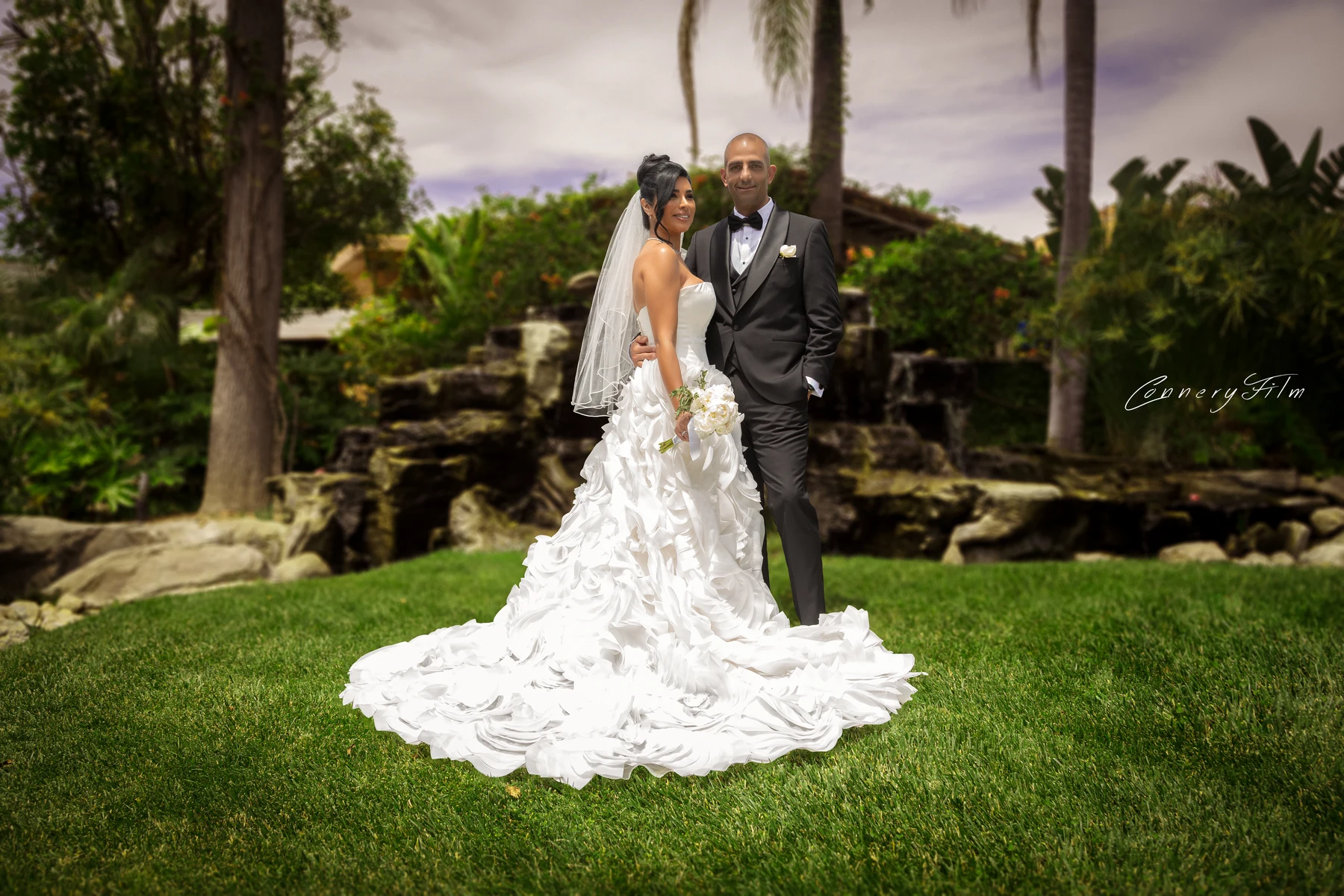
Traditional wedding photography is the posed, planned, shot-list-driven way of documenting a wedding: the photographer directs people into position, works through a set list of portraits and family groupings, and makes sure every expected moment is captured cleanly and evenly lit. If you have ever flipped through your parents' wedding album and seen the couple at the altar, the cake cutting, and twelve carefully arranged family groups on the church steps, you have seen traditional wedding photography. I've been photographing Los Angeles weddings for 17 years, and I still get this question at almost every consultation, usually phrased as "Is traditional photography outdated?" Short answer: no. But it's rarely the whole story anymore.
The Blunt Definition I Give Couples
When a couple sits across from me and asks what traditional means, I tell them this: the photographer is in charge of the picture. In a candid or documentary approach, I wait for things to happen. In a traditional approach, I make things happen. I place Grandma in the chair, I tell the groomsmen where to put their hands, I tilt the bride's chin two degrees toward the window light, and I don't press the shutter until everyone's eyes are open.
The hallmarks are easy to spot:
- Posed portraits of the couple, usually looking at the camera, framed symmetrically.
- Formal family groupings worked through from a written list, often 15 to 30 combinations.
- Wedding party lineups with everyone arranged by height or by side.
- Staged "moment" shots like the ring exchange close-up, the garter, the bouquet toss, and the cake cutting, sometimes paused for a second take.
- Clean, even lighting with flash or reflectors so faces are bright and nobody is lost in shadow.
- Classic editing with true-to-life color, no heavy film looks or moody crushed blacks.
If you want to see how it compares to every other style couples book here, I broke that down in the seven types of wedding photography in Los Angeles.
Where Traditional Photography Came From
For most of the 20th century, traditional was the only option. Cameras were slow, film was expensive, and a photographer might bring a few rolls totaling a couple hundred frames for the entire day. You couldn't afford to fire off 40 frames hoping for a good laugh during the toasts. So photographers staged everything and made each exposure count. Studio portrait habits carried straight into weddings: formal poses, direct eye contact, and a predictable sequence of shots every couple received.
Digital changed the math. Today I'll shoot roughly 3,000 to 4,000 frames at an eight-hour wedding and deliver 500 to 800 edited photos. That freedom is what made candid and photojournalistic styles possible. But here's what most photographers won't tell you: the traditional part of the day didn't go away. It just got less airtime on Instagram.
Honestly, Every Great Wedding Gallery Is Partly Traditional
I'll be blunt: any photographer who says "I don't do posed photos, I'm purely documentary" is either shooting very small elopements or quietly doing formals and not showing them in the portfolio. Your mother wants a clean photo of her with her three kids. Your grandfather might not be at the next family event. Those images need direction, good light, and a list. That is traditional wedding photography, and it's the part of the gallery that gets framed, printed for holiday cards, and put on the table at memorials twenty years later.
What I actually recommend to almost every Los Angeles couple is a blend. Roughly 20 to 30 percent of your gallery will be directed and traditional: family formals, wedding party, a structured set of couple portraits, details. The other 70 to 80 percent is candid storytelling. I wrote more about why you want both in candid vs. posed wedding photos, but the short version is that one style protects the photos your family expects and the other captures the day as it felt.
What Traditional Coverage Looks Like on a Real LA Wedding Day
Here's how the traditional pieces fit into a typical timeline when I'm shooting a 5:00 PM ceremony in late spring, say at an estate in Malibu or a ballroom downtown:
- 1:30 PM, details: rings, invitation suite, shoes, dress on the hanger. Styled and composed, about 30 minutes.
- 2:30 PM, getting-ready portraits: the classic mirror shot, the buttoning of the dress, the groom's tie. Lightly directed.
- 3:30 PM, wedding party portraits: lineups plus a few looser groupings, 20 to 30 minutes.
- 5:00 PM, ceremony: processional, vows, rings, kiss, recessional. Here I shoot unobtrusively, but I make sure every traditional beat is covered from the right angle.
- 5:30 PM, family formals: 20 to 40 minutes depending on the list.
- 6:15 PM, couple portraits: 20 to 30 minutes, ideally timed into the last light.
- Reception: grand entrance, first dance, parent dances, toasts, cake cutting, bouquet toss if you're doing one, and the send-off.
Family formals are the part couples underestimate most. If you're wondering how much time to actually budget, I explain the real numbers in how long wedding photos take after the ceremony.
Why LA Light Makes Traditional Posing Harder Than It Looks
Traditional photography demands even, flattering light on every face in a group. That's harder in Los Angeles than people think. A 3:00 PM ceremony in Pasadena or the San Fernando Valley in September means overhead sun, squinting guests, and raccoon-eye shadows. Put a family of 14 in that light and someone in the back row always ends up half in shade.
When I'm doing formals outdoors, I look for open shade first: the north side of a building, a covered loggia, the tree line on the lawn. On the beach in Santa Monica or Palos Verdes, I'll turn the group so the sun is behind them and fill their faces with flash, which keeps the ocean from blowing out to pure white. Indoors at venues with dark wood and low ceilings, I bounce flash off a wall to get that clean traditional look without the harsh deer-in-headlights effect. This is the craft that separates a good traditional portrait from a snapshot, and it's why I don't think any couple should hire someone who can't work a flash confidently.
Is Traditional Wedding Photography Right for You?
Lean more traditional if:
- You have a large or blended family and want everyone accounted for.
- Your wedding has cultural or religious rituals with specific moments that must be documented, like a Persian sofreh aghd, a Jewish ketubah signing, or a Catholic mass.
- Your parents or grandparents care deeply about a formal album.
- You love classic, timeless images more than trendy editing.
Lean more candid if you're camera-shy, your guest list is under 50, or you'd rather spend your day with guests than standing in lineups. Either way, the answer is to write it down. A tight list of 15 to 25 family groupings beats an endless spreadsheet, and I share mine in my focused wedding shot list.
One more thing worth knowing: the traditional moments are the ones that also matter most on film. When you hire one team for photography and video, like we do at ConneryFilm, the photographer and filmmaker plan the formals, the first dance and the toasts together, so nobody's standing in the other's shot and you're not repeating poses for two separate vendors. It saves 10 to 15 minutes on formals alone, and those minutes usually go straight back to sunset portraits.
What Traditional Photography Costs in Los Angeles
There's no surcharge for "traditional." You're paying for coverage hours and the photographer's skill. In Los Angeles, experienced wedding photographers generally run $3,000 to $6,500 for 8 to 10 hours, and my own photography packages start at $1,599, with photo and film together from $3,500. Where budget matters for a traditional approach is coverage: if you want the full classic sequence from getting ready through the send-off, you need 8 to 10 hours. Cut to 6 and something traditional usually gets dropped, usually the getting-ready portraits or the late reception moments.
Traditional Wedding Photography FAQ
What is the difference between traditional and candid wedding photography?
Traditional photography is directed: the photographer poses people and works from a shot list. Candid photography is observed: the photographer captures real moments as they happen without interrupting. Most modern Los Angeles weddings use both, with about a quarter of the gallery posed.
Is traditional wedding photography outdated?
No. The heavily staged, stiff version from the 1980s is outdated, but posed family formals and classic couple portraits remain the most printed and framed images in nearly every gallery I deliver.
How many posed photos are in a traditional wedding gallery?
For an eight-hour wedding with 500 to 800 delivered images, expect roughly 100 to 200 directed photos, including 15 to 30 family groupings, wedding party portraits, and a structured couple session.
How long do traditional family formals take?
Plan about two minutes per grouping when everyone is present and a family member helps round people up. Twenty groupings takes 30 to 40 minutes; missing relatives are what push it past an hour.
Can I ask for mostly traditional photos with a few candids?
Absolutely. Tell your photographer at the consultation and put it in writing on your timeline. A good photographer will adjust how much time they spend directing versus observing.
If you're planning a Los Angeles wedding and want classic portraits your family will treasure alongside the real, unposed moments, I'd love to hear about your day. Call or text 818.749.7039 or visit ConneryFilm.com to check your date. Photography and film, one team, and a shot list your grandmother will approve of.
Meet the Author: Connery Davoodian Hello, I'm Connery Davoodian, the visionary behind ConneryFilm, and I'm thrilled to share insights from my 17-year journey through the world of wedding photography and videography. My passion extends beyond simply capturing images; it's about artfully weaving your unique love story into a timeless, cinematic masterpiece. My artistic path began long before I ever picked up a camera, deeply rooted in music as a singer, songwriter, and multi-instrumentalist. This diverse background in directing, producing, and editing has cultivated a unique perspective, allowing me to approach each wedding not just as an event, but as a dynamic narrative waiting to be beautifully told. This blend of technical mastery and creative storytelling is the heartbeat of ConneryFilm, ensuring that every frame, every shot, and every film is infused with depth, emotion, and unparalleled artistic integrity. At ConneryFilm, we believe your wedding memories deserve nothing less than bespoke luxury. My philosophy centers on capturing the authentic, unscripted moments – the genuine smiles, the tender glances, the joyful laughter – that truly define your day. While we obsess over exquisite details and sophisticated aesthetics, our true joy comes from making you feel completely at ease, like a "friendor" who genuinely celebrates alongside you. This calm, organized presence allows your true personalities to shine, resulting in images and films that are as real and vibrant as your love itself. Based in the heart of Los Angeles, California, my team and I are privileged to serve couples across the globe, bringing our signature high-end wedding photography and videography to destination weddings worldwide. Through these blog posts, I aim to share invaluable insights, luxurious inspiration, and practical, fun advice to guide you through your wedding planning journey, helping you make informed decisions about preserving your most cherished moments. Thank you for trusting ConneryFilm to be a part of your extraordinary adventure. I'm excited to share my knowledge and passion with you, helping you create memories that will last forever.