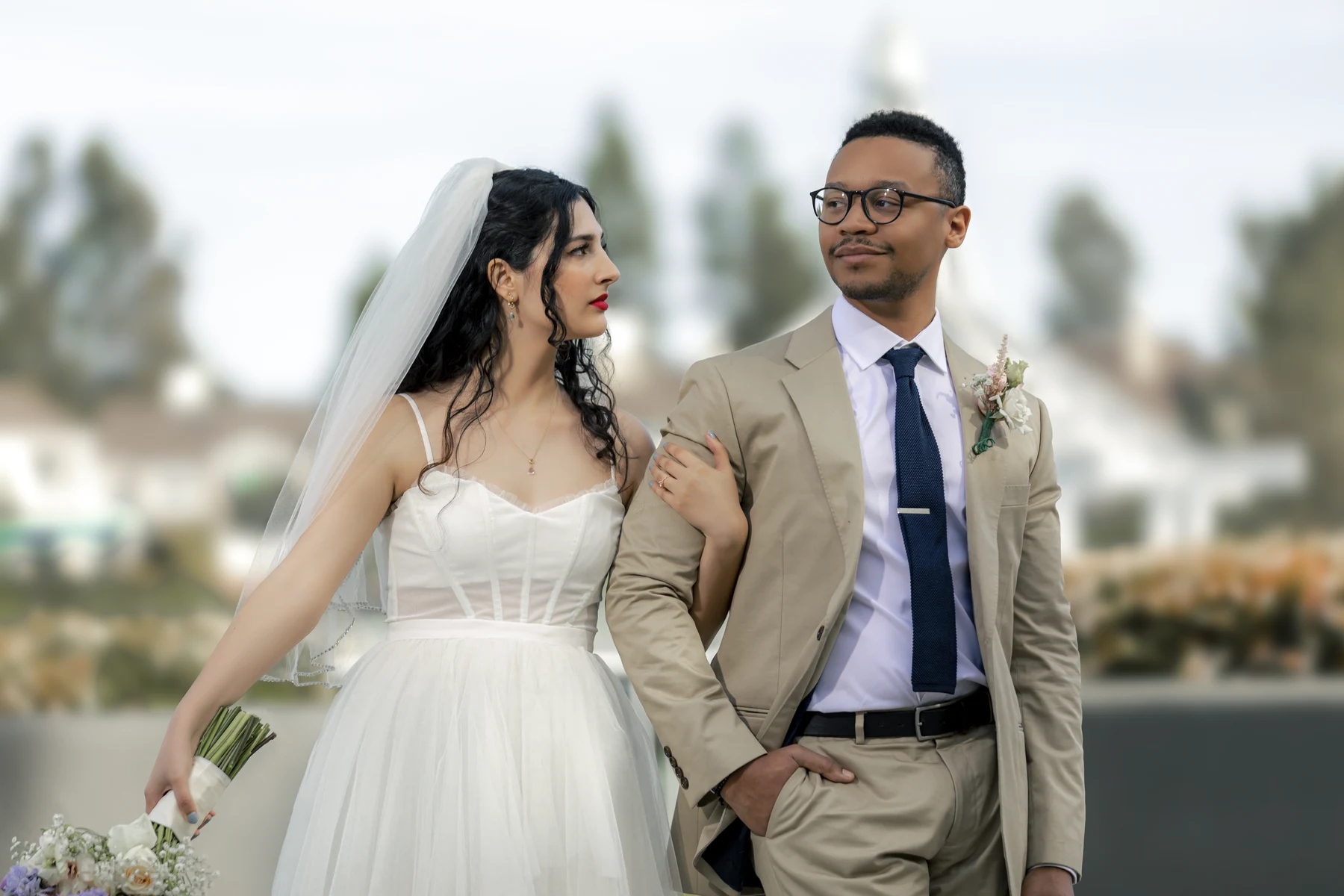
Couples ask me how many outfits for engagement photos they should bring almost every week, usually with a slightly panicked note that they have "six options narrowed down." Here's my honest answer after 17 years of shooting in Los Angeles: bring two outfits. If your session runs two hours and you're moving between two locations, three is the ceiling. Past that, you're not getting more variety in your gallery. You're getting less time in front of the camera and more time in a parked car trying to change jeans.
Let me explain why I'm so firm on this, what each outfit should actually do, and how to plan the change so it doesn't eat the best light of the evening.
The Math Behind Two Outfits
Most engagement sessions run 60 to 120 minutes. I break down how long a typical engagement session runs in another post, but the short version is this: a 90-minute session in LA is really about 75 minutes of shooting once you account for walking, parking and warming up.
Every outfit change costs you somewhere between 10 and 20 minutes. That's finding a restroom or a car, changing, fixing hair, re-applying lipstick, and then a few minutes of getting comfortable again, because people always stiffen up a little after a break. So on a 90-minute session:
- One outfit: roughly 75 minutes of actual photos. Great results, less variety.
- Two outfits: roughly 60 minutes of photos, split into two distinct looks. The sweet spot.
- Three outfits: roughly 45 minutes of photos, and at least one change will land during golden hour. This is where galleries start to suffer.
I'll be blunt: I have never had a couple look at their final gallery and wish they'd squeezed in a third outfit. I have had couples wish they'd had more time in that last 20 minutes of warm light before the sun dropped behind the hills in Malibu.
What Each Outfit Should Actually Do
Two outfits work best when they do two different jobs. I tell couples to think of it as one "dressed up" look and one "you on a Saturday" look.
Outfit one: the elevated look
This is the one your mom will frame. A flowing dress, a tailored suit or a sharp blazer with no tie, a jumpsuit that moves. I like starting with the dressier outfit because everyone's hair and makeup is freshest at the beginning, and we usually start at the more polished location: the Greystone Mansion grounds in Beverly Hills, the arches around Union Station, a rooftop downtown.
Pick fabrics that move. Chiffon, linen, silk, a light wool. Stiff fabrics look stiff in photos, and a skirt that catches a little ocean breeze does half the work for me.
Outfit two: the relaxed look
Jeans, a knit sweater, a simple sundress, a denim jacket, clean sneakers or boots. This is the outfit that produces the laughing-on-a-blanket and walking-down-the-street photos that end up as phone wallpapers. I usually save it for the second half, when we've moved somewhere more casual like the Venice canals, a trail in Griffith Park or the sand at El Matador, and when you've both relaxed into it.
The relaxed look is also your insurance. If the evening gets windy at the beach, a sweater is a lot more forgiving than a silk slip dress.
When a Third Outfit Actually Makes Sense
I'm not anti-third-outfit. I'm anti-third-outfit-by-default. It earns its place in a few specific situations:
- You booked two hours or more. With 120 minutes, a third look is realistic, especially if one change is quick (swapping a jacket, not a full outfit).
- The third outfit is a costume change with a purpose. Wearing jerseys at your first-date spot, a traditional outfit for a cultural element, or matching formal wear for a black-and-white series.
- The locations are genuinely different. Downtown lofts, then a desert-looking trail, then the beach. If the scenery changes that much, the clothes should too.
- One "outfit" is just a layer. Adding a long coat or taking off a blazer counts as a new look in photos and costs you about 30 seconds.
Most photographers won't say this, but the easiest "third outfit" is the layer trick. It gives you visual variety without the 15-minute pit stop.
Coordinating Two People Without Matching
This is where more galleries go wrong than the outfit count. Matching head-to-toe (both in white shirts and khakis) reads as a 2004 family portrait. Clashing (one in neon athleisure, one in a cocktail dress) reads like you arrived from different events.
What works:
- Pick a palette of three colors and each wear one or two of them. Cream, olive and rust. Navy, soft blue and white. Black, camel and gray.
- Match the formality level. If one of you is in a floor-length dress, the other shouldn't be in a hoodie.
- Let one person carry the texture or pattern. A small floral or a knit is great. Two busy patterns fight each other.
- Avoid big logos and tiny stripes. Logos date the photos, and very fine stripes can create a shimmering effect on camera.
- Think about the location color. Bright red against the green of Descanso Gardens pops. Beige against beige sand disappears.
Timing the Change Around LA Light
The single most important rule: never change clothes during golden hour. In summer in Los Angeles, the good light on the coast runs roughly 60 to 45 minutes before sunset, and it goes fast once the sun touches the marine layer or the Santa Monica Mountains.
Here's how I usually structure a 90-minute sunset session:
- First 40 minutes: dressier outfit, open shade or soft side light, more polished location.
- 10-15 minutes: change and drive or walk to the second spot.
- Last 35-40 minutes: relaxed outfit, straight into golden hour and the blue glow after sunset.
If you're shooting at sunrise instead, flip it: the casual outfit often works better first while the light is soft and everyone is still waking up. I compare both options in my post on sunrise vs sunset engagement photos.
Know where you're changing before the day. Restrooms at Griffith Observatory get crowded, many beaches have no facilities near the good spots, and changing in the back of a car in a Malibu pull-out is a classic. A pop-up changing tent costs about $25 online and I've watched it save more sessions than any piece of camera gear.
What I'd Do If It Were My Engagement Session
If I were the one in front of the camera, here's exactly what I'd pack:
- One dressier outfit I feel great in, already worn a couple of times so I know it doesn't pinch or ride up when I sit.
- One relaxed outfit in the same color family.
- One layer (jacket, cardigan, blazer) that can come on or off.
- A second pair of shoes that I can actually walk in, because Los Angeles locations are rarely right next to the parking.
- A lint roller, bobby pins, blotting papers, a steamer-friendly bag and water.
That's it. Two outfits, one layer, and a lot more time actually being together, which is what the camera is really looking for.
This is also one of the reasons I like couples booking photo and film with the same team. At ConneryFilm, photography and cinematic video happen under one roof, so when we plan your engagement session we already know how you move, what colors flatter you and what we'll want to echo on the wedding day. That knowledge carries straight into your engagement and wedding photos with one team instead of starting over with a stranger.
Engagement Photo Outfit FAQ
Is one outfit enough for engagement photos?
Yes, especially for a 60-minute session at a single location. One great outfit gives you more shooting time and fewer interruptions. You'll get plenty of variety from changing poses, framing and light.
Should we bring a backup outfit just in case?
Keep a simple backup in the car, like a neutral sweater or a plain top. Spilled coffee and surprise beach wind happen more than you'd think, and a backup only costs you time if you actually need it.
Can my dog or a prop count as an outfit change?
Not really, but bringing your dog for the first 15 minutes is a great way to add variety without a change. Plan for a friend to take the dog home afterward so we're not wrangling a leash during golden hour.
How many engagement photos will we get with two outfits?
Outfit count doesn't change the total much. Most couples receive somewhere between 40 and 80 finished images from a 90-minute session, and I explain why in my post on how many engagement photos you actually need.
Should we wear white or all black?
Both can work, but solid white can look flat in bright midday sun and all black loses detail in dark urban locations. Soft neutrals and mid-tones are the safest choice for most LA spots.
If you're planning your engagement session and want a second opinion on your outfits, your location or your timing, I'd genuinely love to help you think it through. Call or text 818.749.7039 or visit ConneryFilm.com to tell me about your plans, and we'll build a session that gives you more time being yourselves and less time changing in the car.
Meet the Author: Connery Davoodian Hello, I'm Connery Davoodian, the visionary behind ConneryFilm, and I'm thrilled to share insights from my 17-year journey through the world of wedding photography and videography. My passion extends beyond simply capturing images; it's about artfully weaving your unique love story into a timeless, cinematic masterpiece. My artistic path began long before I ever picked up a camera, deeply rooted in music as a singer, songwriter, and multi-instrumentalist. This diverse background in directing, producing, and editing has cultivated a unique perspective, allowing me to approach each wedding not just as an event, but as a dynamic narrative waiting to be beautifully told. This blend of technical mastery and creative storytelling is the heartbeat of ConneryFilm, ensuring that every frame, every shot, and every film is infused with depth, emotion, and unparalleled artistic integrity. At ConneryFilm, we believe your wedding memories deserve nothing less than bespoke luxury. My philosophy centers on capturing the authentic, unscripted moments – the genuine smiles, the tender glances, the joyful laughter – that truly define your day. While we obsess over exquisite details and sophisticated aesthetics, our true joy comes from making you feel completely at ease, like a "friendor" who genuinely celebrates alongside you. This calm, organized presence allows your true personalities to shine, resulting in images and films that are as real and vibrant as your love itself. Based in the heart of Los Angeles, California, my team and I are privileged to serve couples across the globe, bringing our signature high-end wedding photography and videography to destination weddings worldwide. Through these blog posts, I aim to share invaluable insights, luxurious inspiration, and practical, fun advice to guide you through your wedding planning journey, helping you make informed decisions about preserving your most cherished moments. Thank you for trusting ConneryFilm to be a part of your extraordinary adventure. I'm excited to share my knowledge and passion with you, helping you create memories that will last forever.